Identification
Rosa chinensis is a shrub of variable habit with three or five leaflets and single or semi-double flowers from light pink to crimson. Trees and Shrubs Online calls it “essentially a race of garden roses”, shaped by long selection in Chinese gardens.
Names and synonyms
Jacquin published Rosa chinensis in 1768. European literature also called the plant Rosa semperflorens, Rosa indica and other names; the table lists the homotypic synonyms and misapplied names recorded in WCVP, with the full synonymy below it.
| Name | Published in |
|---|---|
| Rosa chinensis Jacq. | Observ. Bot. 3: 7 (1768) |
| Rosa bengalensis chinensis (Jacq.) Pers. | Syn. Pl. 2: 50 (1806) |
Misapplied names (names used for this species in error): Rosa indica auct. non Lour.
51 heterotypic synonyms
| Rosa bengalensis Pers. | Syn. Pl. 2: 50 (1806) |
| Rosa bengalensis odorata Wallr. | Ros. Pl. Gen. Hist.: 107 (1828) |
| Rosa bengalensis odoratissima Wallr. | Ros. Pl. Gen. Hist.: 107 (1828) |
| Rosa chinensis f. spontanea Rehder & E.H.Wilson | C.S.Sargent, Pl. Wilson. 2: 320 (1915) |
| Rosa chinensis f. viridiflora (Lavallée) C.K.Schneid. | Ill. Handb. Laubholzk. 1: 546 (1905) |
| Rosa chinensis prol. indica (Koehne) R.Keller | P.F.A.Ascherson & K.O.R.Graebner, Syn. Mitteleur. Fl. 6(1): 45 (1900) |
| Rosa chinensis prol. semperflorens (W.M.Curtis) R.Keller | P.F.A.Ascherson & K.O.R.Graebner, Syn. Mitteleur. Fl. 6(1): 45 (1900) |
| Rosa chinensis semperflorens K.Koch | Dendrologie 1: 273 (1869) |
| Rosa chinensis subsp. indica Koehne | Deut. Dendrol.: 281 (1893) |
| Rosa chinensis var. coccinea Yu Y.Yang & L.Luo | Rosa China: 435 (2024) |
| Rosa chinensis var. devoniensis Rehder | L.H.Bailey, Cycl. Amer. Hort. 4: 1551 (1902) |
| Rosa chinensis var. erubescens Yu Y.Yang & L.Luo | Rosa China: 439 (2024) |
| Rosa chinensis var. indica (Koehne) Rehder | L.H.Bailey, Cycl. Amer. Hort. 4: 1551 (1902) |
| Rosa chinensis var. longifolia (Willd.) Rehder | L.H.Bailey, Cycl. Amer. Hort. 4: 1551 (1902) |
| Rosa chinensis var. minima (Sims) Voss | Vilm. Blumengärtn., ed. 3. 1: 257 (1894) |
| Rosa chinensis var. multijuga Yu Y.Yang & L.Luo | Rosa China: 441 (2024) |
| Rosa chinensis var. persicina Yu Y.Yang & L.Luo | Rosa China: 437 (2024) |
| Rosa chinensis var. pubescens Yu Y.Yang & L.Luo | Rosa China: 433 (2024) |
| Rosa chinensis var. semperflorens (W.M.Curtis) Koehne | Deut. Dendrol.: 281 (1893) |
| Rosa chinensis var. spontanea (Rehder & E.H.Wilson) T.T.Yu & T.C.Ku | Fl. Reipubl. Popularis Sin. 37: 423 (1985) |
| Rosa chinensis viridiflora Dippel | Handb. Laubholzk. 3: 562 (1893) |
| Rosa diversifolia Vent. | Descr. Pl. Nouv.: t. 35 (1801) |
| Rosa diversifolia var. viridiflora Lavallée | Hort. Franç. 1856: 218 (1856) |
| Rosa indica Lindl. | Ros. Monogr.: 106 (1820) |
| Rosa indica pumila Thory | P.J.Redouté & C.A.Thory, Roses 1: 115 (1817) |
| Rosa indica var. bengalensis K.Koch | Hort. Dendrol.: 122 (1853) |
| Rosa indica var. humilis Ser. | Mél. Bot. 1: 44 (1818) |
| Rosa indica var. longifolia (Willd.) Lindl. | Ros. Monogr.: 106 (1820) |
| Rosa indica var. minima Bean | Trees & Shrubs Brit. Isles 2: 430 (1914) |
| Rosa indica var. pumila (Thory) Lindl. | Ros. Monogr.: 106 (1820) |
| Rosa indica var. semperflorens (W.M.Curtis) Ser. | A.P.de Candolle, Prodr. 2: 601 (1825) |
| Rosa indica var. vulgaris Thory | P.J.Redouté & C.A.Thory, Roses 1: 51 (1817) |
| Rosa laurentiae Tratt. | Rosac. Monogr. 1: 105 (1823) |
| Rosa lawranceana Sweet | Hort. Suburb. Lond.: 119 (1818) |
| Rosa longifolia Willd. | Sp. Pl., ed. 4. 2: 1097 (1799) |
| Rosa monstrosa Breiter | Hort. Breiter.: 425 (1817) |
| Rosa nankinensis Lour. | Fl. Cochinch. 1: 324 (1790) |
| Rosa nanula Hoffmanns. | Verz. Pfl.-Kult.: 108 (1824) |
| Rosa rouletii Correvon | Gard. Chron., ser. 3, 72: 342 (1922) |
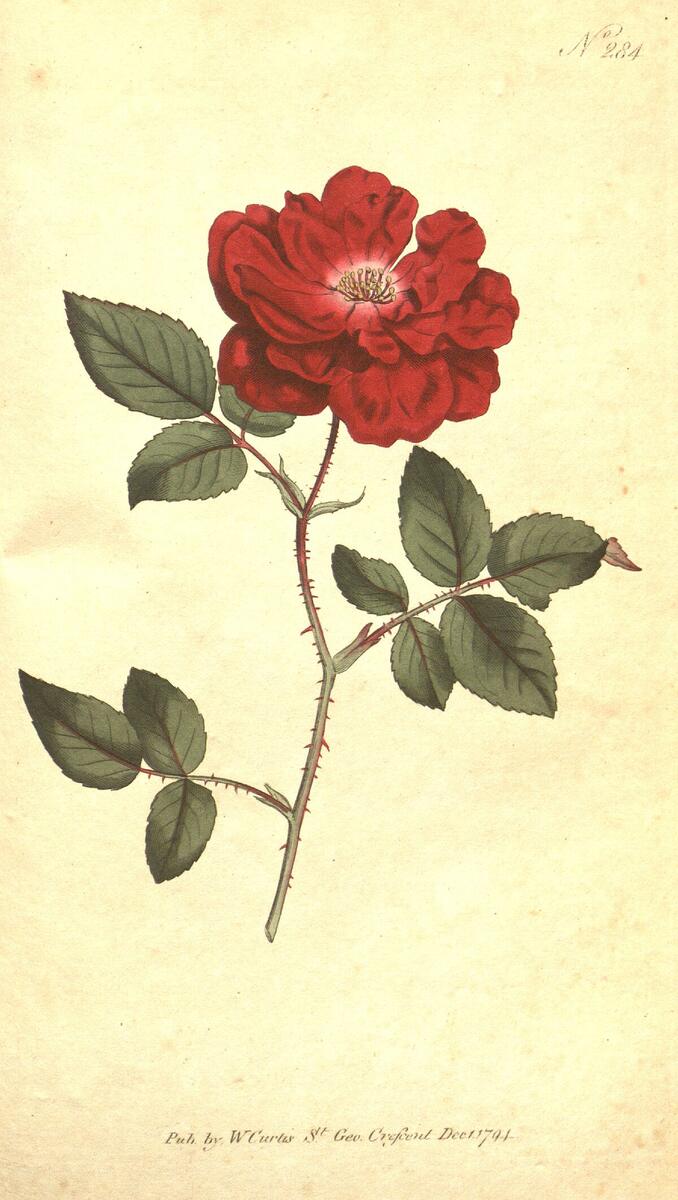
| Rosa semperflorens W.M.Curtis | Bot. Mag. 8: t. 284 (1794) |
| Rosa semperflorens carnea Redouté | P.J.Redouté & C.A.Thory, Roses 1: t. 19 (1817) |
| Rosa semperflorens carnea Rössig | unknown publication |
| Rosa semperflorens minor Andrews | Roses Monogr. 2: t. 73 (1826) |
| Rosa semperflorens simplex Andrews | Roses Monogr. 2: t. 74 (1805-1828) |
| Rosa semperflorens var. longifolia (Willd.) Regel | Trudy Imp. S.-Peterburgsk. Bot. Sada 5: 356 (1878) |
| Rosa semperflorens var. manettii Regel | Trudy Imp. S.-Peterburgsk. Bot. Sada 5: 357 (1878) |
| Rosa semperflorens var. minima Sims | Bot. Mag. 42: t. 1762 (1815) |
| Rosa semperflorens var. molinerii Spin | Jard. St. Sebastien, ed. 1818: 33 (1818) |
| Rosa semperflorens var. viridiflora Regel | Trudy Imp. S.-Peterburgsk. Bot. Sada 5: 357 (1878) |
| Rosa sinica L. | J.A.Murray (ed.), Syst. Veg., ed. 13.: 394 (1774) |
| Rosa sinica var. typica Regel | Trudy Imp. S.-Peterburgsk. Bot. Sada 5: 327 (1878) |
Distribution
WCVP records the species as native to 2 TDWG botanical regions and introduced in 22 more.
China North-CentralChina South-Central
Introduced
AlabamaAssamBelgiumBulgariaCook Is.GreeceGuatemalaGulf of Guinea Is.IndiaInner MongoliaItalyKazakhstanKoreaLaosNepalPakistanQueenslandUzbekistanVanuatuVietnamWest HimalayaWestern Australia
Historic plates and the names printed on them
Plates carry the name in use at the time. Using the WCVP synonymy and misapplied names, the table maps each printed name to the current species or subspecies.
| Printed name · source | Current name | |
|---|---|---|
| Rosa semperflorens(正文) Curtis's Botanical Magazine · 284 · 1794 | Rosa chinensis Jacq. WCVP synonym: Rosa semperflorens W.M.Curtis |
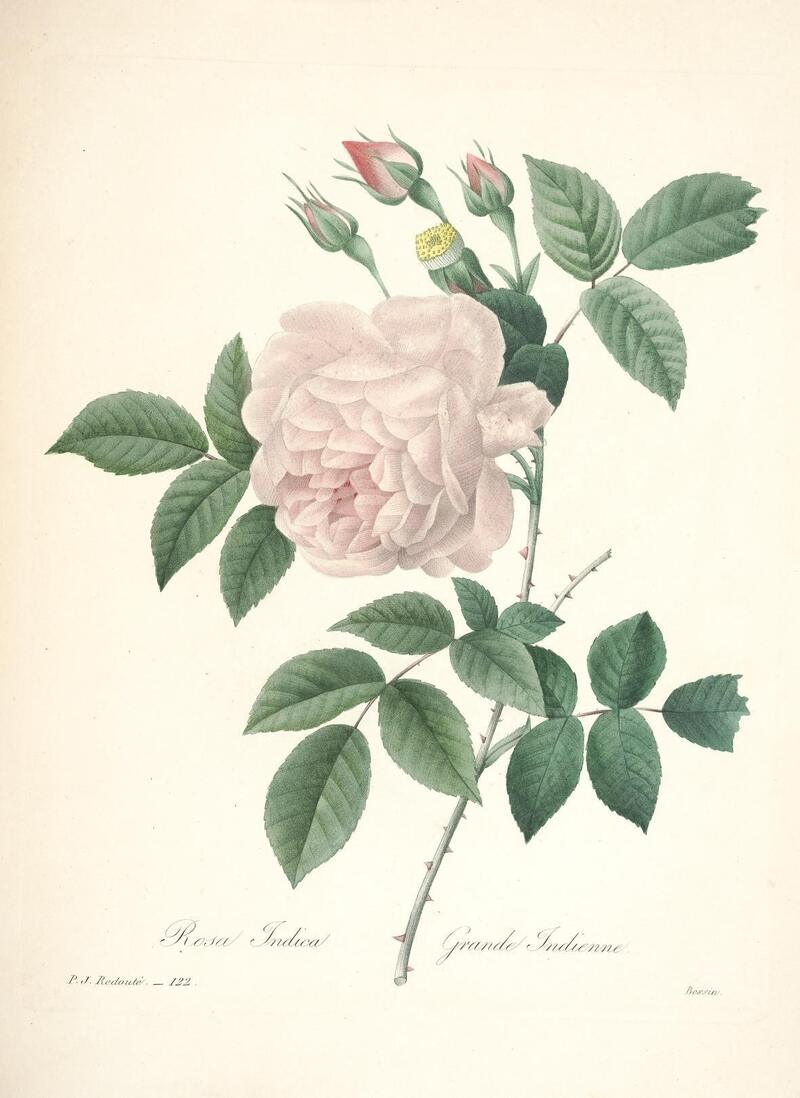 | Rosa Indica Choix des plus belles fleurs · 122 · 1827–1833 | Rosa chinensis Jacq. misapplied name (WCVP: Rosa indica auct. non Lour.) |
Arrival in Europe and repeat flowering
Its chief gift to modern roses is repeat flowering: successive crops of flowers on the same stem. China roses reached Europe at the end of the eighteenth century: the Pink China came to Britain through Joseph Banks in 1789, ‘Slater’s Crimson China’ about 1791, ‘Parsons’ Pink China’ was in commerce by 1793, ‘Hume’s Blush Tea-scented China’ arrived a few years before 1810 and ‘Parks’ Yellow’ was collected in China in 1824. Through two lines of descent the Pink China is an ancestor of most modern garden roses.