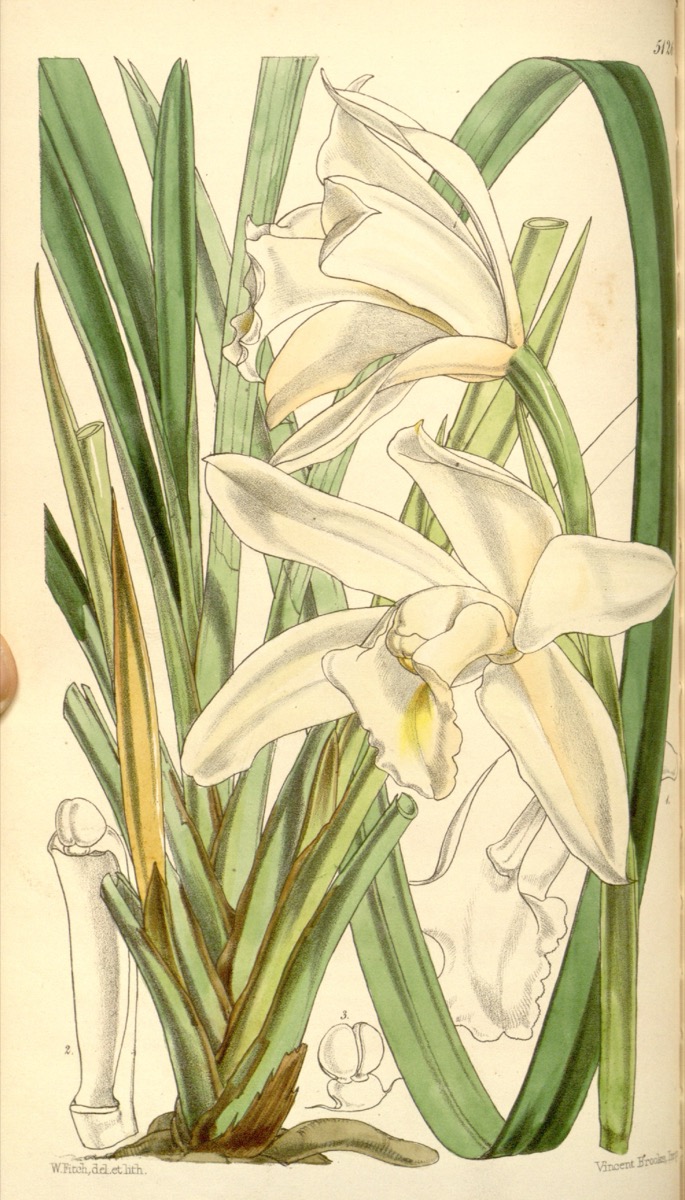
Cymbidium Sw.
boat orchids · Orchidaceae
- Accepted name
- Cymbidium Sw.
- First published
- Nova Acta Regiae Soc. Sci. Upsal., ser. 2, 6: 70 (1799)
- Family
- Orchidaceae
- Accepted species
- 118 (including 26 natural hybrids)
- Native range
- 37 TDWG regions, tropical and subtropical Asia to northern Australia
- Common names
- boat orchids
- Databases
- POWO · IPNI · WCVP · Catalogue of Life · GBIF
Overview
Cymbidium belongs to the orchid family, Orchidaceae, ranging from tropical and subtropical Asia to northern Australia. In horticulture and floristry, it divides into two distinct groups: the traditional terrestrial Chinese cymbidiums (such as C. faberi, C. goeringii, and C. ensifolium), cherished for subtle fragrance and foliage; and the large-flowered Cymbidium hybrids developed from epiphytic and semi-epiphytic wild species, renowned worldwide as festive potted plants and durable cut flowers.
Classification and naming
Swartz published Cymbidium in 1799. The name derives from the Greek kymbe (boat), referring to the hollowed boat-like lip. WCVP currently treats genera such as Cyperorchis, Imerinaea, and Pachyrhizanthe as synonyms of Cymbidium.
| Genus name | Published in |
|---|---|
| × Cyperocymbidium A.D.Hawkes | Orchid Rev. 72: 420 (1964) |
| Arethusantha Finet | Bull. Soc. Bot. France 44: 179 (1897) |
| Cymbidiopsis H.J.Chowdhery | Indian J. Forest. 32: 154 (2009) |
| Cyperorchis Blume | Rumphia 4: 47 (1849) |
| Iridorchis Blume | Coll. Orchid.: 90 (1859) |
| Jensoa Raf. | Fl. Tellur. 4: 38 (1838) |
| Liuguishania Z.J.Liu & J.N.Zhang | J. S. China Agric. Univ. 19(1): 73 (1998) |
| Pachyrhizanthe (Schltr.) Nakai | Bot. Mag. (Tokyo) 45: 109 (1931) |
| Wutongshania Z.J.Liu & J.N.Zhang | J. S. China Agric. Univ. 19(1): 74 (1998) |
Distribution
WCVP records the genus as native to 37 TDWG botanical regions and introduced in 1 more.
Andaman Is.AssamBangladeshBorneoCambodiaChina North-CentralChina South-CentralChina SoutheastEast HimalayaHainanIndiaJapanJawaKoreaLaosLesser Sunda Is.MalayaMalukuMyanmarNansei-shotoNepalNew GuineaNew South WalesNicobar Is.Northern TerritoryPakistanPhilippinesQueenslandSri LankaSulawesiSumateraTaiwanThailandTibetVietnamWest HimalayaWestern Australia
Introduced
Hawaii
Accepted species
WCVP accepts 118 species; names with × are natural hybrids. The count changes with revisions; checked 2026-10-20.
| Name | On this site |
|---|---|
| Cymbidium acuminatum M.A.Clem. & D.L.Jones | |
| Cymbidium aliciae Quisumb. | |
| Cymbidium aloifolium (L.) Sw. | |
| Cymbidium atrolabium X.Y.Liao, S.R.Lan & Z.J.Liu | |
| Cymbidium atropurpureum (Lindl.) Rolfe | |
| Cymbidium × ballianum Rolfe | |
| Cymbidium banaense Gagnep. | |
| Cymbidium × baoshanense F.Y.Liu & Perner | |
| Cymbidium bavuongii Aver. & V.C.Nguyen | |
| Cymbidium bicolor Lindl. | |
| Cymbidium biflorens D.Y.Zhang, S.R.Lan & Z.J.Liu | |
| Cymbidium borneense J.J.Wood | |
| Cymbidium brevifolium Zhuang Zhou, S.R.Lan & Z.J.Liu | |
| Cymbidium canaliculatum R.Br. | |
| Cymbidium changningense Z.J.Liu & S.C.Chen | |
| Cymbidium × charlesworthii Rolfe & Hurst | |
| Cymbidium chloranthum Lindl. | |
| Cymbidium cochleare Lindl. | |
| Cymbidium codonanthum Yuting Jiang, Liang Ma & S.Chen | |
| Cymbidium concinnum Z.J.Liu & S.C.Chen | |
| Cymbidium crassifolium Herb. | |
| Cymbidium × cravenianim Anon. | |
| Cymbidium cyperifolium Wall. ex Lindl. | |
| Cymbidium daweishanense G.Q.Zhang & Z.J.Liu | |
| Cymbidium dayanum Rchb.f. | |
| Cymbidium defoliatum Y.S.Wu & S.C.Chen | |
| Cymbidium devonianum Paxton | |
| Cymbidium dianlan H.He | |
| Cymbidium × dilatatiphyllum J.M.H.Shaw | |
| Cymbidium eburneum Lindl. | 1 plate |
| Cymbidium elegans Lindl. | |
| Cymbidium elongatum J.J.Wood, Du Puy & Shim | |
| Cymbidium ensifolium (L.) Sw. | 1 plate |
| Cymbidium erythraeum Lindl. | |
| Cymbidium erythrostylum Rolfe | |
| Cymbidium faberi Rolfe | reference page |
| Cymbidium finlaysonianum Lindl. | |
| Cymbidium floribundum Lindl. | |
| Cymbidium × florinda Rolfe | |
| Cymbidium formosanum Hayata | |
| Cymbidium × fugongense S.Ke, S.R.Lan & Z.J.Liu | |
| Cymbidium × gammieanum King & Pantl. | |
| Cymbidium gaoligongense Z.J.Liu & J.Yong Zhang | |
| Cymbidium × glebelandense Rolfe | |
| Cymbidium goeringii (Rchb.f.) Rchb.f. | |
| Cymbidium haematodes Lindl. | |
| Cymbidium hartinahianum J.B.Comber & Nasution | |
| Cymbidium hengbungense A.N.Rao, Chowlu, H.B.Sharma, K.S.Thithila & D.S.Thokchom | |
| Cymbidium × hillii F.Muell. ex Regel | |
| Cymbidium hookerianum Rchb.f. | |
| Cymbidium huikanran Jun Li bis & S.R.Lan | |
| Cymbidium induratifolium Z.J.Liu & J.N.Zhang | |
| Cymbidium insigne Rolfe | 1 plate |
| Cymbidium iridioides D.Don | 1 plate |
| Cymbidium jiangchengense Ying L.Peng, S.R.Lan & Z.J.Liu | |
| Cymbidium kanran Makino | |
| Cymbidium lancifolium Hook. | |
| Cymbidium ledinhhienii Aver., Vuong & V.C.Nguyen | |
| Cymbidium lii M.Z.Huang, J.M.Yin & G.S.Yang | |
| Cymbidium longipes Z.J.Liu & J.N.Zhang | |
| Cymbidium lowianum (Rchb.f.) Rchb.f. | |
| Cymbidium macrorhizon Lindl. | |
| Cymbidium madidum Lindl. | |
| Cymbidium × magnificum Schltr. | |
| Cymbidium maguanense F.Y.Liu | |
| Cymbidium × malipoense L.J.Chen, Hong B.Zhou & Z.J.Liu | |
| Cymbidium × maronii Rolfe & Hurst | |
| Cymbidium mastersii Griff. ex Lindl. | |
| Cymbidium micranthum Z.J.Liu & S.C.Chen | |
| Cymbidium × monanthum J.M.H.Shaw | |
| Cymbidium motuoense W.Q.Hu, Qinghai Zhang & Z.J.Liu | |
| Cymbidium munronianum King & Pantl. | |
| Cymbidium nanulum Y.S.Wu & S.C.Chen | |
| Cymbidium × nishiuchianum Makino ex J.M.H.Shaw | |
| Cymbidium × nomachianum T.Yukawa & Nob.Tanaka | |
| Cymbidium × nujiangense X.P.Zhou, S.P.Lei & Z.J.Liu | |
| Cymbidium × oblancifolium Z.J.Liu & S.C.Chen | |
| Cymbidium omeiense Y.S.Wu & S.C.Chen | |
| Cymbidium parishii Rchb.f. | |
| Cymbidium × pauwelsii J.G.Fowler | |
| Cymbidium puerense Z.J.Liu & S.R.Lan | |
| Cymbidium × purpuratum L.J.Chen, Li.Q.Li & Z.J.Liu | |
| Cymbidium purpureisepalum M.J.Zhu & S.R.Lan | |
| Cymbidium qiubeiense K.M.Feng & H.Li | |
| Cymbidium rectum Ridl. | |
| Cymbidium recurvatum Z.J.Liu, S.C.Chen & P.J.Cribb | |
| Cymbidium repens Aver. & Q.T.Phan | |
| Cymbidium × rosefieldense Rolfe | |
| Cymbidium roseum J.J.Sm. | |
| Cymbidium sanderae (Rolfe) P.J.Cribb & Du Puy | |
| Cymbidium sangii Aver. & V.C.Nguyen | |
| Cymbidium schroederi Rolfe | |
| Cymbidium × sedenii Rolfe & Hurst | |
| Cymbidium seidenfadenii (P.J.Cribb & Du Puy) P.J.Cribb | |
| Cymbidium serratum Schltr. | |
| Cymbidium shidianense G.Z.Chen, G.Q.Zhang & L.J.Chen | |
| Cymbidium sichuanicum Z.J.Liu & S.C.Chen | |
| Cymbidium sigmoideum J.J.Sm. | |
| Cymbidium sinense (Andrews) Willd. | 1 plate |
| Cymbidium suave R.Br. | |
| Cymbidium suavissimum Sander ex C.H.Curtis | |
| Cymbidium sungwookii Aver., Vuong & V.C.Nguyen | |
| Cymbidium tamphianum Aver. | |
| Cymbidium teretipetiolatum Z.J.Liu & S.C.Chen | |
| Cymbidium tigrinum C.S.P.Parish ex Hook. | |
| Cymbidium tortisepalum Fukuy. | |
| Cymbidium tracyanum L.Castle | |
| Cymbidium × veitchii Rolfe & Hurst | |
| Cymbidium viride Sanjeet Kumar | |
| Cymbidium wadae T.Yukawa | |
| Cymbidium weishanense X.Yu & Z.J.Liu | |
| Cymbidium wenshanense Y.S.Wu & F.Y.Liu | |
| Cymbidium whiteae King & Pantl. | |
| Cymbidium × wiganianum Rolfe & Hurst | |
| Cymbidium wilsonii H.J.Veitch | |
| Cymbidium × winnianum Anon. | |
| Cymbidium × woodlandense Rolfe | |
| Cymbidium xichouense Xin Y.Xu, C.C.Ding & S.R.Lan |
Historic plates
Plates in date order; the printed names are kept as they appear, current names are on the species pages and the topic page.
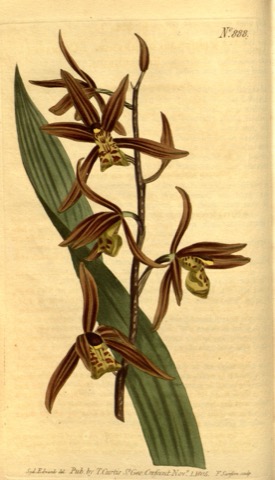
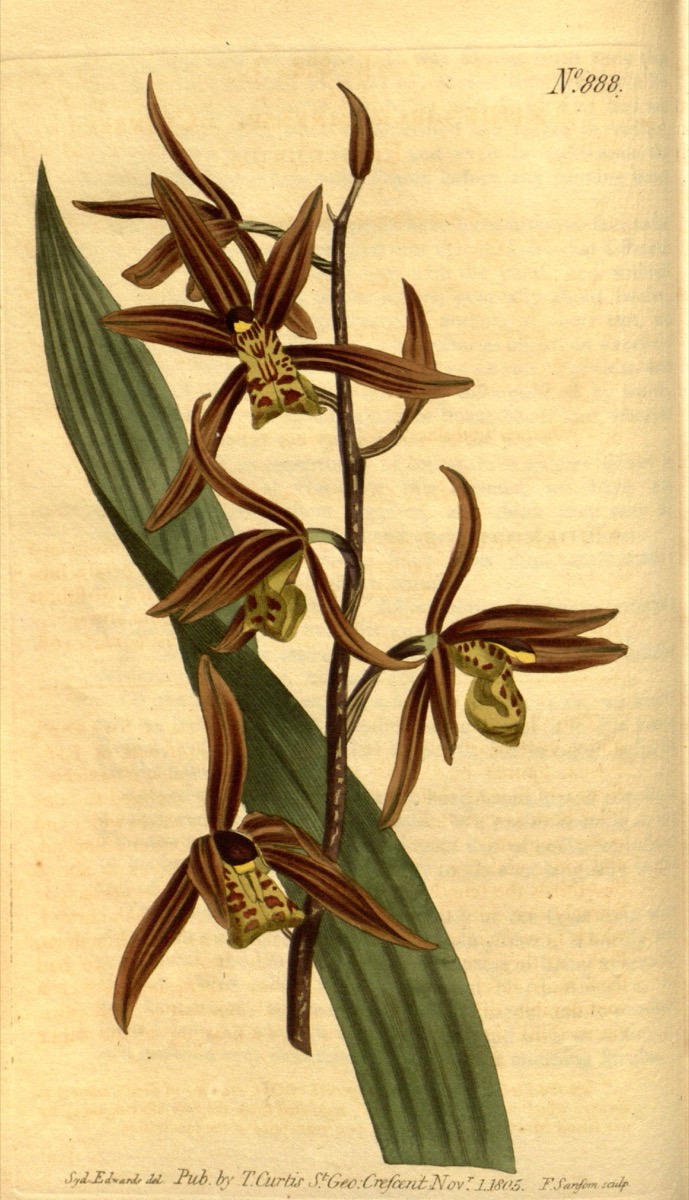
Epidendrum sinense
Curtis's Botanical Magazine · 888 · 1806
Sydenham Edwards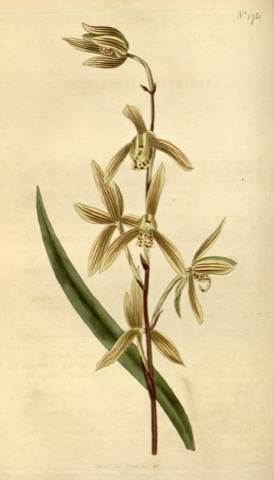
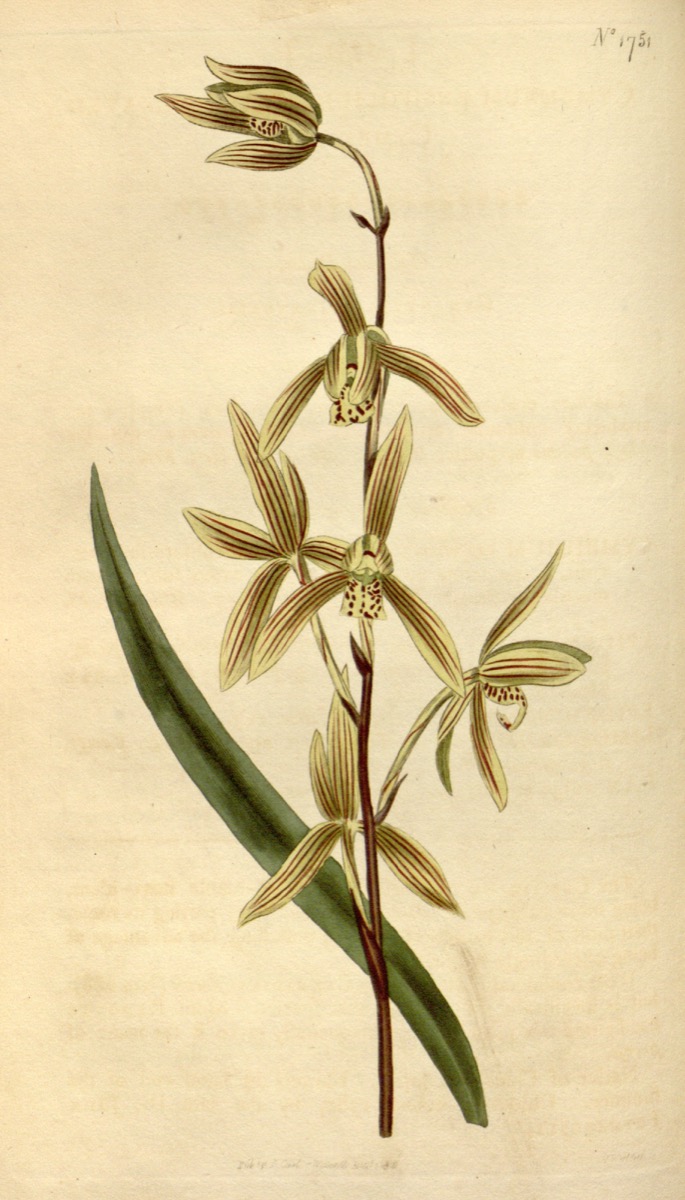
Cymbidium ensifolium
Curtis's Botanical Magazine · 1751 · 1815
Sydenham Edwards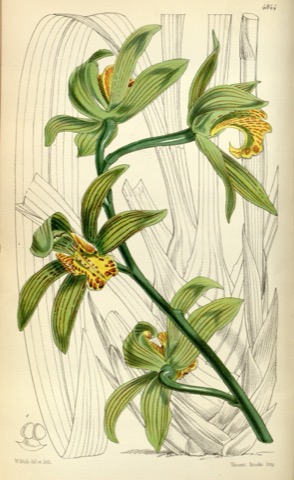
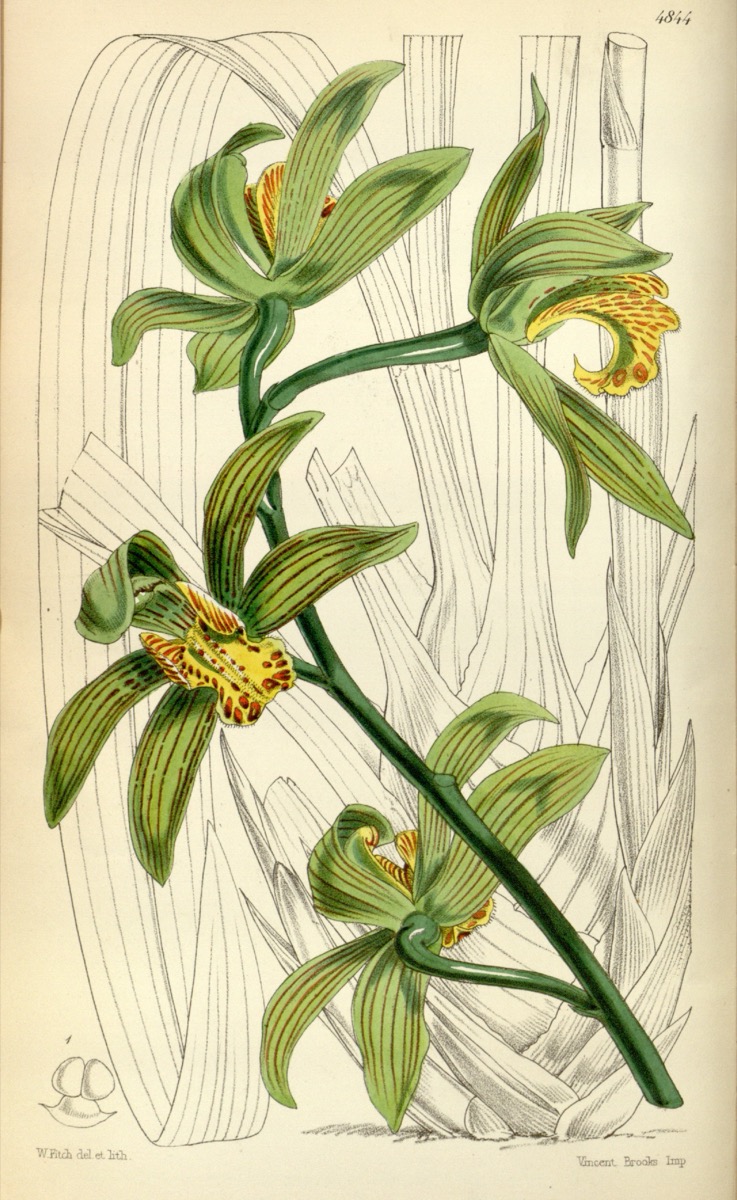
Cymbidium giganteum
Curtis's Botanical Magazine · 4844 · 1855
Walter Hood Fitch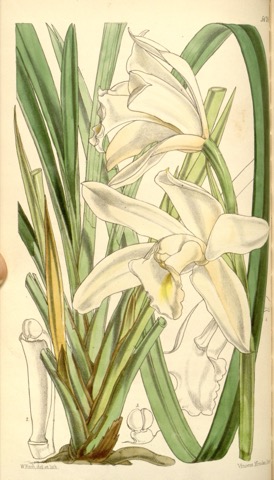
Cymbidium eburneum
Curtis's Botanical Magazine · 5126 · 1859
Walter Hood Fitch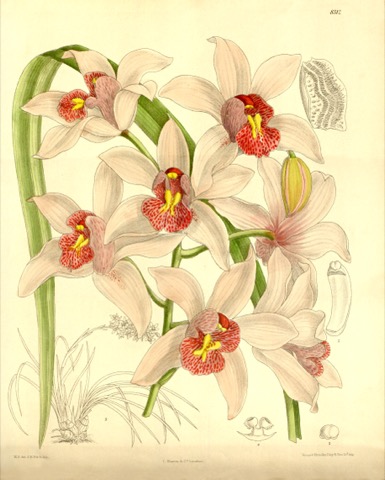
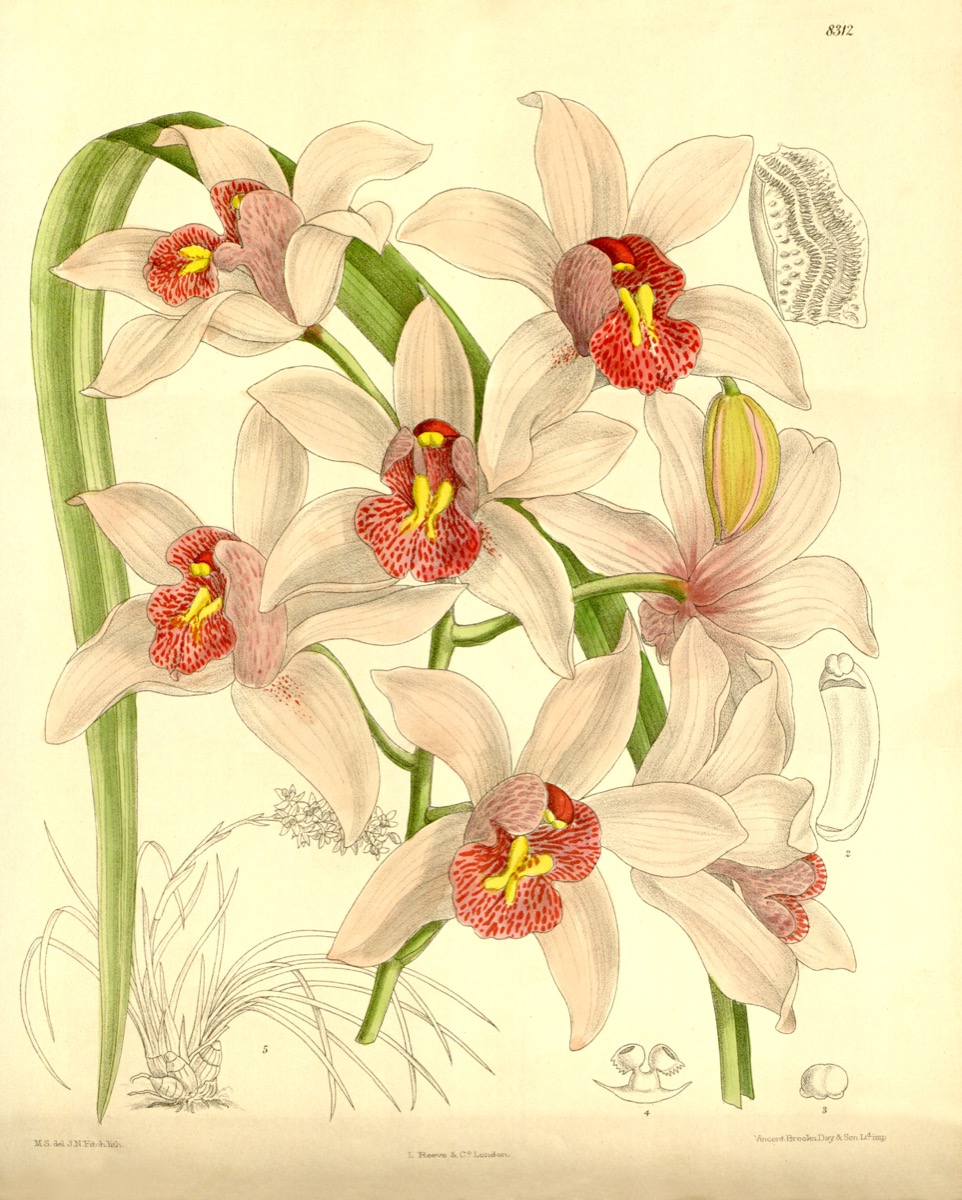
Cymbidium insigne
Curtis's Botanical Magazine · 8312 · 1910
Matilda Smith
Horticulture and floristry
Cymbidium hybrids require cooler night temperatures (10–14 °C) in autumn to initiate flower spikes. As cut flowers, they offer robust stems and exceptional vase life of 2–3 weeks in cool conditions. Postharvest handling requires strict protection from ethylene: accidental dislodging of the anther cap triggers rapid ethylene generation and causes swift discoloration and wilting.