Protea L.
proteas · Proteaceae
- Accepted name
- Protea L.
- First published
- Mant. Pl. 2: 187 (1771)
- Family
- Proteaceae
- Accepted species
- 107 (including 0 natural hybrids)
- Native range
- 35 TDWG regions, tropical and southern Africa, richest in the Cape
- Common names
- proteas
- Databases
- POWO · IPNI · WCVP · Catalogue of Life · GBIF
Overview
Protea belongs to the protea family, Proteaceae. WCVP records the genus across Africa, from the Cape Provinces to Nigeria, Ethiopia and Kenya in tropical Africa, though most species are South African. SANBI notes that the family had already split into two subfamilies before Gondwana broke up about 140 million years ago; southern Africa has about 360 species, more than 330 of them confined to the Cape Floral Kingdom. The genus is named after Proteus, the Greek god who could change his shape at will, for its great variety of habit, flower size and colour.
The best known is the king protea, P. cynaroides, South Africa’s national flower and a famous cut flower. SANBI describes its “flower” as a head of many florets surrounded by large coloured bracts, 120–300 mm across, from creamy white to deep crimson, the silvery pale pink forms being most prized. Because forms from different localities flower at different times, it can be grown for export markets through the year, and it is now cultivated widely in New Zealand, Australia and Hawaii.
Classification and naming
WCVP cites Linnaeus’s Mantissa Plantarum (1771) as the place of publication. SANBI’s account of the silver tree, Leucadendron argenteum, tells the story: Linnaeus based his definition of Protea on the silver tree, calling it Protea argentea; in 1807 and 1810 Salisbury and Robert Brown reorganised the family into the genera recognised today, and Brown redefined and conserved the name Leucadendron, based on the silver tree. That is why Leucadendron appears among the generic synonyms below.
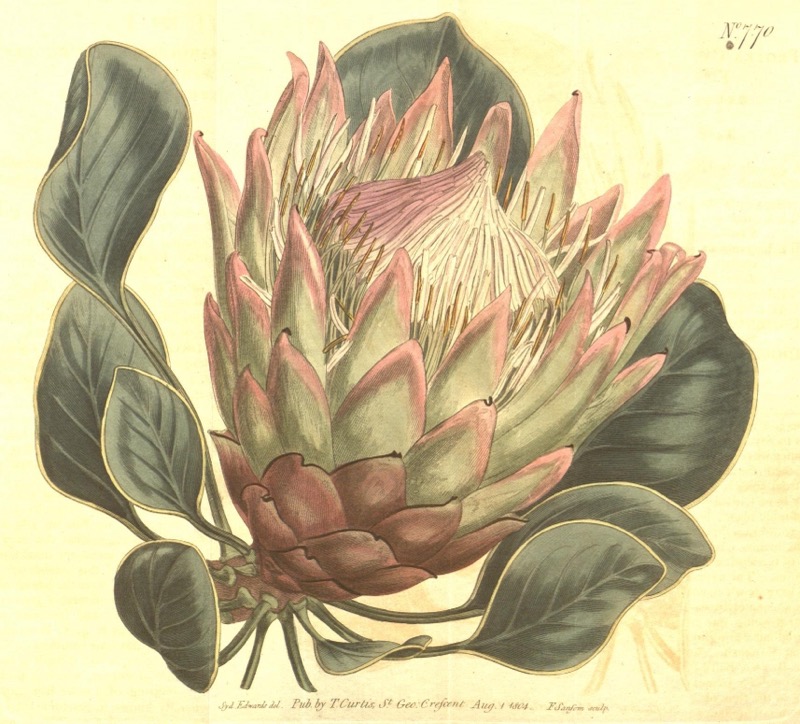
The king protea’s epithet cynaroides means “like an artichoke”, after its bud (SANBI). The plate above is P. cynaroides from Curtis’s Botanical Magazine, plate 770 (1804).
| Genus name | Published in |
|---|---|
| Chrysodendron Vaill. ex Meisn. | A.P.de Candolle, Prodr. 14: 230 (1856) |
| Erodendrum Salisb. | Parad. Lond. 1: t. 67 (1807) |
| Leucadendron L. | Sp. Pl.: 91 (1753) |
| Pleuranthe Salisb. | Cult. Prot.: 49 (1809) |
| Serraria Adans. | Fam. Pl. 2: 284 (1763) |
Distribution
WCVP records the genus as native to 35 TDWG botanical regions.
AngolaBeninBotswanaBurkinaBurundiCameroonCape ProvincesCaprivi StripCentral African RepublicChadDR CongoEritreaEswatiniEthiopiaFree StateGhanaGuineaIvory CoastKenyaKwaZulu-NatalLesothoMalawiMaliMozambiqueNamibiaNigeriaNorthern ProvincesRwandaSierra LeoneSudan-South SudanTanzaniaTogoUgandaZambiaZimbabwe
Accepted species
WCVP accepts 107 species; names with × are natural hybrids. The count changes with revisions; checked 2026-10-24.
| Name | On this site |
|---|---|
| Protea acaulos (L.) Reichard | |
| Protea acuminata Sims | |
| Protea afra Meisn. | |
| Protea amplexicaulis (Salisb.) R.Br. | |
| Protea angolensis Welw. | |
| Protea angustata R.Br. | |
| Protea argyrea Hauman | |
| Protea aristata E.Phillips | |
| Protea aspera E.Phillips | |
| Protea asymmetrica Beard | |
| Protea aurea (Burm.f.) Rourke | |
| Protea baumii Engl. & Gilg | |
| Protea burchellii Stapf | |
| Protea caespitosa Andrews | |
| Protea canaliculata Andrews | |
| Protea compacta R.Br. | |
| Protea comptonii Beard | |
| Protea convexa E.Phillips | |
| Protea cordata Thunb. | |
| Protea coronata Lam. | |
| Protea cryophila Bolus | |
| Protea curvata N.E.Br. | |
| Protea cynaroides (L.) L. | 1 plate |
| Protea decurrens E.Phillips | |
| Protea dekindtiana Engl. | |
| Protea denticulata Rourke | |
| Protea dracomontana Beard | |
| Protea effusa E.Mey. ex Meisn. | |
| Protea enervis Wild | |
| Protea eximia (Knight) Fourc. | |
| Protea flavopilosa Beard | |
| Protea foliosa Rourke | |
| Protea gaguedi J.F.Gmel. | |
| Protea glabra Thunb. | |
| Protea grandiceps Tratt. | |
| Protea heckmanniana Engl. | |
| Protea holosericea (Salisb. ex Knight) Rourke | |
| Protea humiflora Andrews | |
| Protea humifusa Meisn. | |
| Protea inopina Rourke | |
| Protea intonsa Rourke | |
| Protea kibarensis Hauman | |
| Protea lacticolor Salisb. | |
| Protea laetans L.E Davidson | |
| Protea laevis R.Br. | |
| Protea lanceolata E.Mey. ex Meisn. | |
| Protea laurifolia Thunb. | |
| Protea lepidocarpodendron (L.) L. | |
| Protea linearifolia Engl. | |
| Protea longifolia Andrews | |
| Protea lorea R.Br. | |
| Protea lorifolia (Knight) Fourc. | |
| Protea madiensis Oliv. | |
| Protea mafingensis (Chisumpa & Brummitt) Beard | |
| Protea magnifica Andrews | |
| Protea matonchiana Chisumpa & Brummitt | |
| Protea micans Welw. | |
| Protea minima Hauman | |
| Protea montana E.Mey. ex Meisn. | |
| Protea mucronifolia Salisb. | |
| Protea mundii Klotzsch | |
| Protea namaquana Rourke | |
| Protea nana (P.J.Bergius) Thunb. | |
| Protea neriifolia R.Br. | |
| Protea nitida Mill. | |
| Protea nubigena Rourke | |
| Protea obtusifolia H.Buek ex Meisn. | |
| Protea odorata Thunb. | |
| Protea ongotium Beard | |
| Protea paludosa (Hiern) Engl. | |
| Protea parvula Beard | |
| Protea pendula R.Br. | |
| Protea petiolaris (Hiern) Baker & C.H.Wright | |
| Protea piscina Rourke | |
| Protea pityphylla E.Phillips | |
| Protea poggei Engl. | |
| Protea praticola Engl. | |
| Protea pruinosa Rourke | |
| Protea pudens Rourke | |
| Protea punctata Meisn. | |
| Protea recondita H.Buek ex Meisn. | |
| Protea repens (L.) L. | 1 plate |
| Protea restionifolia (Salisb. ex Knight) Rycroft | |
| Protea revoluta R.Br. | |
| Protea roupelliae Meisn. | |
| Protea rubrobracteata Engl. | |
| Protea rubropilosa Beard | |
| Protea rupestris R.E.Fr. | |
| Protea rupicola Mund ex Meisn. | |
| Protea scabra R.Br. | |
| Protea scabriuscula E.Phillips | |
| Protea scolopendriifolia (Salisb. ex Knight) Rourke | |
| Protea scolymocephala (L.) Reichard | 1 plate |
| Protea scorzonerifolia (Salisb. ex Knight) Rycroft | |
| Protea simplex E.Phillips | |
| Protea speciosa (L.) L. | |
| Protea stokoei E.Phillips | |
| Protea subulifolia (Knight) Rourke | |
| Protea subvestita N.E.Br. | |
| Protea sulphurea E.Phillips | |
| Protea susannae E.Phillips | |
| Protea tenax (Salisb.) R.Br. | |
| Protea venusta Compton | |
| Protea vogtsiae Rourke | |
| Protea welwitschii Engl. | |
| Protea wentzeliana Engl. | |
| Protea witzenbergiana E.Phillips |
Historic plates
Plates in date order; the printed names are kept as they appear, current names are on the species pages and the topic page.
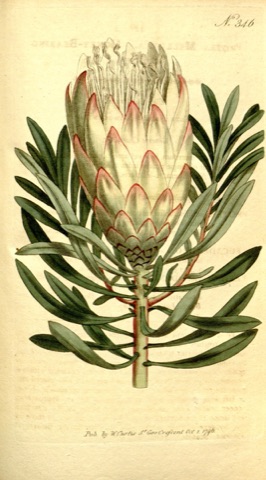
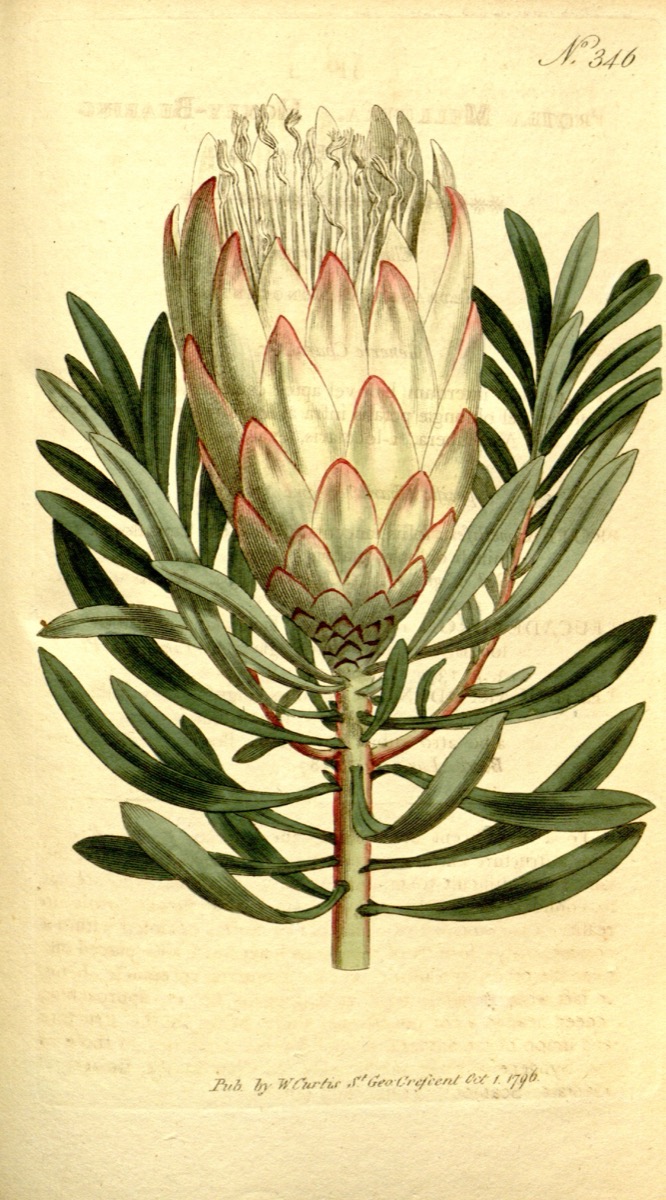
Protea mellifera
Curtis's Botanical Magazine · 346 · 1796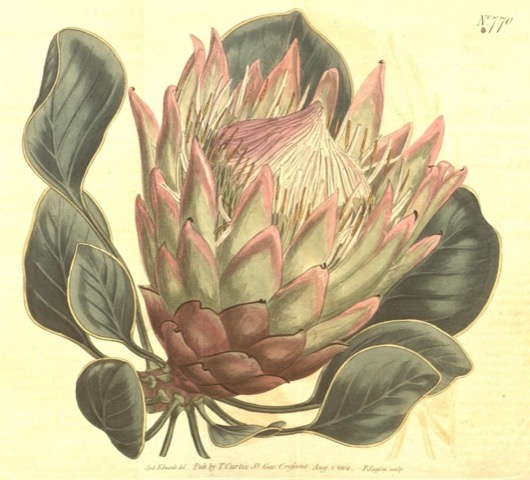
Protea cynaroides
Curtis's Botanical Magazine · 770 · 1804
Sydenham Edwards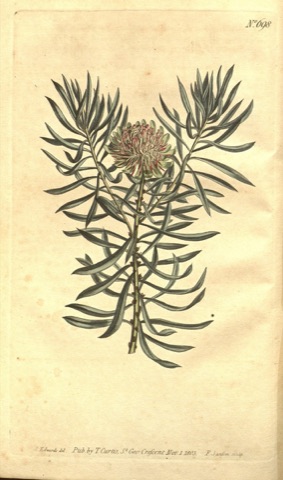
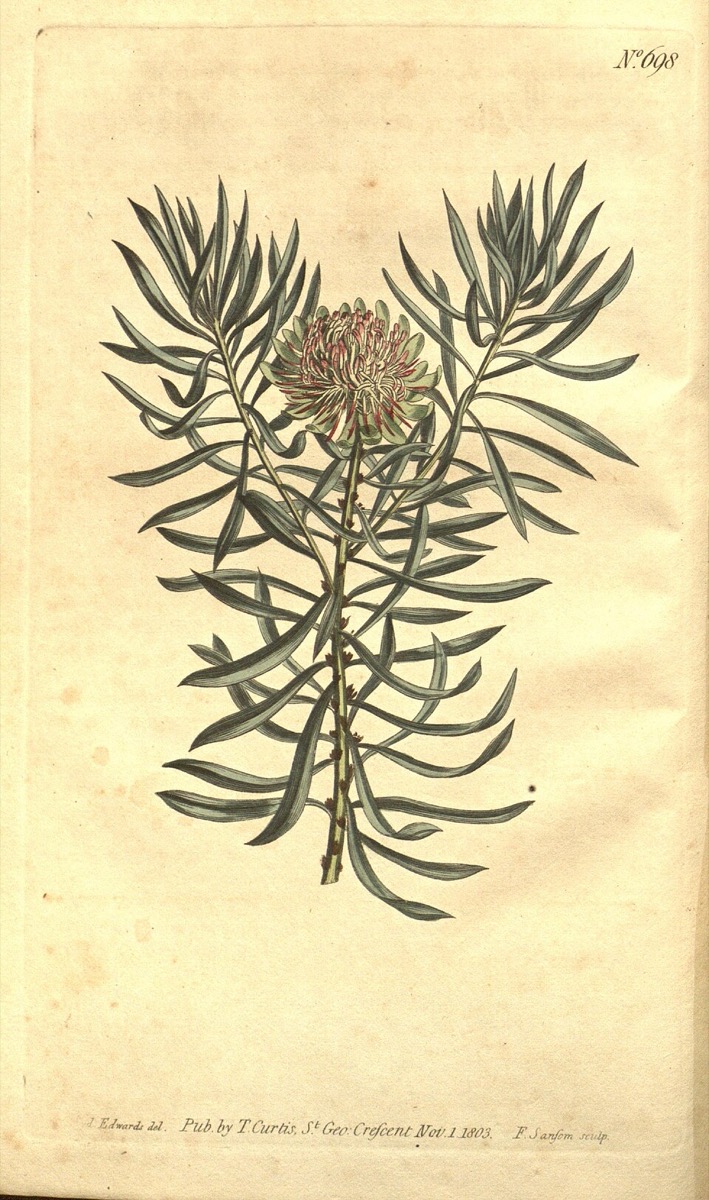
Protea scolymus
Curtis's Botanical Magazine · 698 · 1804
Sydenham Edwards
Ecology and cut-flower handling
SANBI notes that king proteas are pollinated by birds such as sugarbirds and sunbirds, and grow in fire-prone vegetation where natural fires come every ten to thirty years, resprouting from a thick underground woody stem (lignotuber). The florets open over a long period, which makes the head a lasting garden sight and a long-lived cut flower.
Floralife notes that proteas are not tropical flowers that must never be refrigerated, but prefer milder chilling: 4–10 °C, ideally 4 °C at 85% humidity. Vase life is 10–20 days, ethylene sensitivity is low and they perform well in foam. Stems are cut when mature (no soft tips) and the flowers when at least the outer florets are fully expanded; check that the leaves are not black. Leaf blackening is linked to low light and storage conditions: keep proteas in a well-lit place, use flower food and avoid high temperatures; decaying leaves in buckets and lack of hydration also contribute.