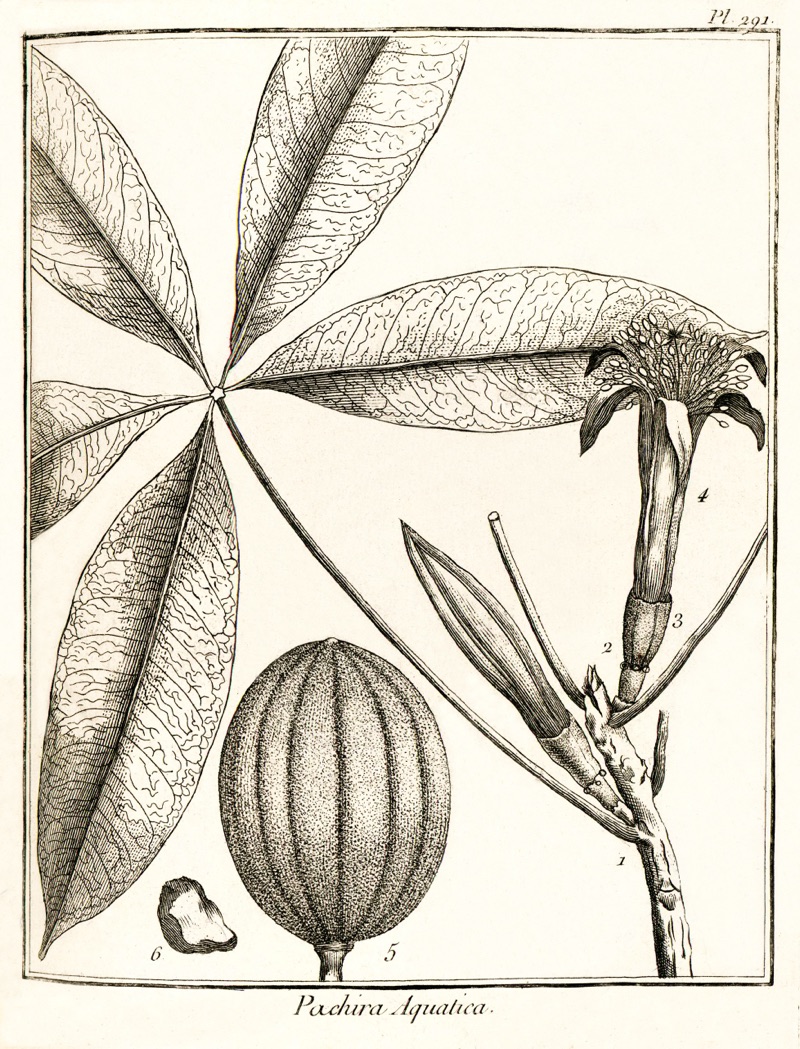
Pachira Aubl.
pachiras · Malvaceae
- Accepted name
- Pachira Aubl.
- First published
- Hist. Pl. Guiane: 725 (1775)
- Family
- Malvaceae
- Accepted species
- 54 (including 0 natural hybrids)
- Native range
- 28 TDWG regions, Mexico to tropical America
- Common names
- pachiras
- Databases
- POWO · IPNI · WCVP · Catalogue of Life · GBIF
Overview
Pachira belongs to the family Malvaceae (formerly Bombacaceae); Kew gives its native range as Mexico to tropical America. Flora of China counts about 50 species in tropical America, with only one, the introduced P. aquatica, cultivated in China; the species WCVP accepts are listed below.
The “money tree” of plant shops is recorded as P. aquatica by Flora of China, NC State Extension and the ASPCA. WCVP also accepts P. glabra as a separate species, which Kew records as native to south-eastern and southern Brazil, while NC State’s page lists Bombax glabrum as a former name of P. aquatica. Horticultural sources draw the line between the two differently, so the identity table records both and does not decide which species the plants on sale belong to.
Classification and characters
WCVP cites Aublet’s Histoire des Plantes de la Guiane Françoise (1775) as the place of publication and sinks Bombacopsis, Carolinea and Rhodognaphalopsis, among others, as synonyms.
Flora of China describes trees, sometimes deciduous, spiny or buttressed, with palmately compound leaves of 3–11 leaflets. The bisexual flowers are solitary or in clusters of two or three in the leaf axils, with 90–1000 stamens joined into a tube at the base. The fruit is oblong to pear-shaped, woody or leathery, splitting into five valves and woolly inside, with large seeds up to 2.5 cm.
P. aquatica is a small tree 4–5 m tall (up to 18 m), with 5–11 leaflets, the central one 13–24 cm long. Its yellowish-green petals are narrowly lanceolate to thread-like, up to 15 cm long, with the upper half reflexed; the staminal tube is yellow below and red above, 13–15 cm long with the filaments. The capsule is nearly pear-shaped, 9–10 cm long, and the dark brown seeds have white spirals. It flowers from May to November and is cultivated in Guangdong, Taiwan and southern Yunnan; native to tropical America, it is now cultivated and naturalised throughout the tropics, and the seeds are eaten raw or roasted (Flora of China).
| Genus name | Published in |
|---|---|
| Bombacopsis Pittier | Contr. U.S. Natl. Herb. 18: 162 (1916) |
| Carolinea L.f. | Suppl. Pl.: 51 (1782) |
| Raussinia Neck. | Elem. Bot. 2: 419 (1790) |
| Rhodognaphalopsis A.Robyns | Bull. Jard. Bot. État Bruxelles 33: 272 (1963) |
| Sophia L. | Pl. Surin.: 11 (1775) |
Distribution
WCVP records the genus as native to 28 TDWG botanical regions and introduced in 33 more.
BelizeBoliviaBrazil NorthBrazil NortheastBrazil SouthBrazil SoutheastColombiaCosta RicaCubaDominican RepublicEcuadorEl SalvadorFrench GuianaGuatemalaGuyanaHaitiHondurasMexico CentralMexico GulfMexico NorthwestMexico SoutheastMexico SouthwestNicaraguaPanamáPeruSurinameTrinidad-TobagoVenezuela
Introduced
BeninBrazil West-CentralBurundiCabindaCameroonCaroline Is.ChadComorosCongoDR CongoGhanaGuineaGulf of Guinea Is.Ivory CoastJamaicaLeeward Is.LiberiaMaliMarianasNew CaledoniaNigeriaPuerto RicoRwandaSenegalSierra LeoneSudan-South SudanTanzaniaUgandaVenezuelan AntillesVietnamWindward Is.ZambiaZimbabwe
Accepted species
WCVP accepts 54 species; names with × are natural hybrids. The count changes with revisions; checked 2026-10-28.
| Name | On this site |
|---|---|
| Pachira amazonica (A.Robyns) W.S.Alverson | |
| Pachira aquatica Aubl. | 1 plate |
| Pachira aracamuniana (Steyerm.) W.S.Alverson | |
| Pachira brevipes (A.Robyns) W.S.Alverson | |
| Pachira calophylla (K.Schum.) Fern.Alonso | |
| Pachira cearensis (Ducke) Carv.-Sobr. & Dorr | |
| Pachira condorensis Fern.Alonso & J.E.Guevara | |
| Pachira coriacea (Mart.) W.S.Alverson | |
| Pachira cowanii (A.Robyns) W.S.Alverson | |
| Pachira cubensis (A.Robyns) Fern.Alonso | |
| Pachira deflexifolia V.N.Yoshik. & M.C.Duarte | |
| Pachira dolichocalyx A.Robyns | |
| Pachira duckei (A.Robyns) Fern.Alonso | |
| Pachira dugandeana (A.Robyns) Fern.Alonso | |
| Pachira emarginata A.Rich. | |
| Pachira endecaphylla (Vell.) Carv.-Sobr. | |
| Pachira faroensis (Ducke) W.S.Alverson | |
| Pachira flaviflora (Pulle) Fern.Alonso | |
| Pachira fuscolepidota (Steyerm.) W.S.Alverson | |
| Pachira glabra Pasq. | |
| Pachira gracilis (A.Robyns) W.S.Alverson | |
| Pachira humilis Otto & A.Dietr. | |
| Pachira inaequalivalvis V.N.Yoshik. & M.C.Duarte | |
| Pachira insignis (Sw.) Savigny | |
| Pachira liesneri (Steyerm.) W.S.Alverson | |
| Pachira macrocalyx (Ducke) Fern.Alonso | |
| Pachira manausensis (A.Robyns) V.N.Yoshik. & C.D.M.Ferreira | |
| Pachira mawarinumae (Steyerm.) W.S.Alverson | |
| Pachira minor (Sims) Otto & A.Dietr. | |
| Pachira morae Fern.Alonso | |
| Pachira moreirae Carv.-Sobr. & W.S.Alverson | |
| Pachira mutisiana Fern.Alonso | |
| Pachira nervosa (Uittien) Fern.Alonso | |
| Pachira nitida Kunth | |
| Pachira nukakica Fern.Alonso | |
| Pachira obovata (A.Robyns) W.S.Alverson | |
| Pachira orinocensis (A.Robyns) W.S.Alverson | |
| Pachira paraensis (Ducke) W.S.Alverson | |
| Pachira patinoi (Dugand & A.Robyns) Fern.Alonso | |
| Pachira pseudofaroensis (A.Robyns) W.S.Alverson | |
| Pachira pulchra Planch. & Linden | |
| Pachira punga-schunkei Fern.Alonso | |
| Pachira retusa (Mart.) Fern.Alonso | |
| Pachira robynsii (Steyerm. & W.D.Stevens) W.S.Alverson | |
| Pachira rupicola (A.Robyns) W.S.Alverson | |
| Pachira rurrenabaqueana (Rusby) Fern.Alonso | |
| Pachira sessilis Benth. | |
| Pachira sordida (R.E.Schult.) W.S.Alverson | |
| Pachira speciosa Triana & Planch. | |
| Pachira subandina (Dugand) Fern.Alonso | |
| Pachira tepuiensis (Steyerm.) W.S.Alverson | |
| Pachira tocantina (Ducke) Fern.Alonso | |
| Pachira trinitensis Urb. | |
| Pachira yapacanae Steyerm. ex W.S.Alverson |
Historic plates
Plates in date order; the printed names are kept as they appear, current names are on the species pages and the topic page.
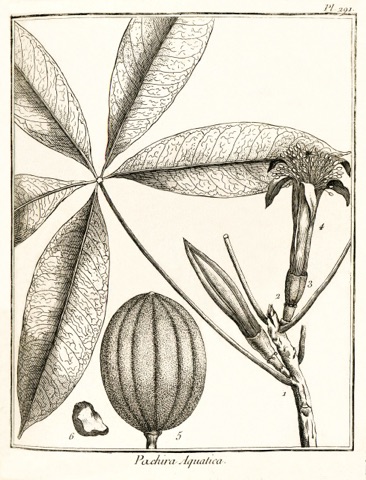
Pachira Aquatica
Histoire des plantes de la Guiane Françoise · Pl. 291 · 1775
Pot culture and safety
Flora of China notes that potted P. aquatica is very tolerant of drought and shade and is sold in many countries as a houseplant, usually with braided stems. NC State Extension adds that the trunks are flexible enough to braid together, a practice begun in Taiwan to lock in good fortune. Indoors it usually stays at 2–2.5 m (6–8 ft); it prefers indirect light or part shade, as direct sun scorches the leaves, and 18–24 °C with good humidity; the potting mix should be moist but well drained, as standing water causes root rot; and indoor or braided plants generally do not flower.
The ASPCA lists the money tree (P. aquatica) as non-toxic to dogs, cats and horses, though eating it may cause nausea, vomiting and loose stools. NC State notes that the seeds, which contain cyclopropenoid fatty acids, are the poisonous part, and can cause mild to moderate gastrointestinal upset in cats.
References
- WCVP · World Checklist of Vascular Plants (via ChecklistBank dataset 2232) · accessed 2026-10-28
- Kew (POWO data on the ColPlanta site) · Pachira native range
- Flora of China vol. 12 · Pachira
- Flora of China vol. 12 · Pachira aquatica
- NC State Extension Plant Toolbox · Pachira aquatica
- ASPCA Animal Poison Control · Money Tree