Clivia Lindl.
clivias · Amaryllidaceae
- Accepted name
- Clivia Lindl.
- First published
- Bot. Reg. 14: t. 1182 (1828)
- Family
- Amaryllidaceae
- Accepted species
- 8 (including 2 natural hybrids)
- Native range
- 4 TDWG regions, South Africa
- Common names
- clivias
- Databases
- POWO · IPNI · WCVP · Catalogue of Life · GBIF
Overview
Clivia belongs to the family Amaryllidaceae, and Kew records the genus as native only to South Africa; the species WCVP accepts, two of them natural hybrids, are listed below. The RHS notes that clivias come from the woodlands of South Africa.
The clivia of florists and New Year markets is mainly C. miniata, which Kew records as native to South Africa and growing as an epiphyte, chiefly in the subtropical biome. The RHS also recommends the pale yellow C. miniata var. citrina and C. nobilis, with curved red-and-yellow, green-tipped flowers.
Classification and characters
WCVP cites Lindley’s description in the Botanical Register 14, plate 1182 (1828), as the place of publication. The synonyms Imatophyllum, Imantophyllum and Himantophyllum are 19th-century names and spellings for the same genus, often seen in old books and plates.
The RHS describes C. miniata as bearing clusters of orange, funnel-shaped flowers with a yellow throat. Flowers indoors are often unpollinated: red berries may form, but the seed inside is not viable unless the flowers were hand-pollinated, and seedlings take three to four years to flower.
| Genus name | Published in |
|---|---|
| Himantophyllum Spreng. | Gen. Pl. 1: 276 (1830) |
| Imantophyllum Hook. | Bot. Mag. 80: t. 4783 (1854) |
| Imatophyllum Hook. | Bot. Mag. 55: t. 2856 (1828) |
Distribution
WCVP records the genus as native to 4 TDWG botanical regions and introduced in 3 more.
Cape ProvincesEswatiniKwaZulu-NatalNorthern Provinces
Introduced
Mexico CentralMexico SoutheastMexico Southwest
Accepted species
WCVP accepts 8 species; names with × are natural hybrids. The count changes with revisions; checked 2026-10-28.
| Name | On this site |
|---|---|
| Clivia caulescens R.A.Dyer | |
| Clivia × cyrtanthiflora (Lindl. ex K.Koch & Fintelm) T.Moore | |
| Clivia gardenii Hook. | |
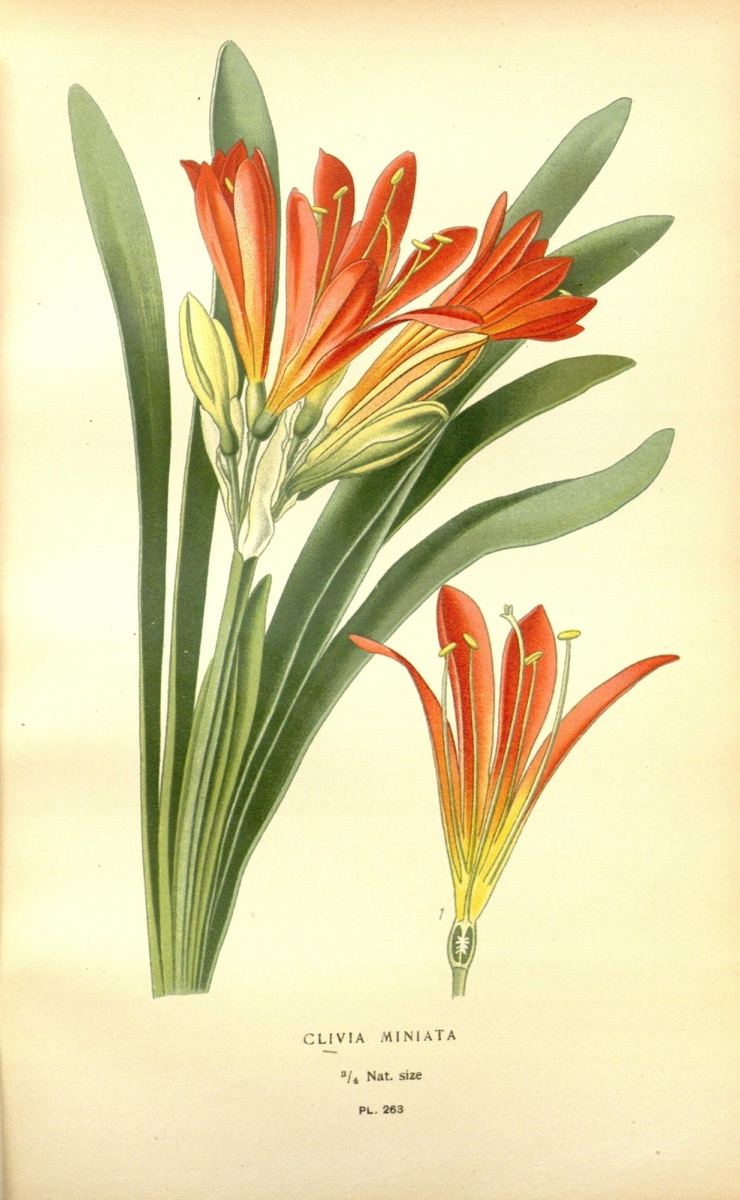
| Clivia miniata (Lindl.) Verschaff. | 1 plate |
| Clivia mirabilis Rourke | |
| Clivia × nimbicola Swanev., Truter & A.E.van Wyk | |
| Clivia nobilis Lindl. | 1 plate |
| Clivia robusta B.G.Murray, Ran, de Lange, Hammett, Truter & Swanev. |
Historic plates
Plates in date order; the printed names are kept as they appear, current names are on the species pages and the topic page.
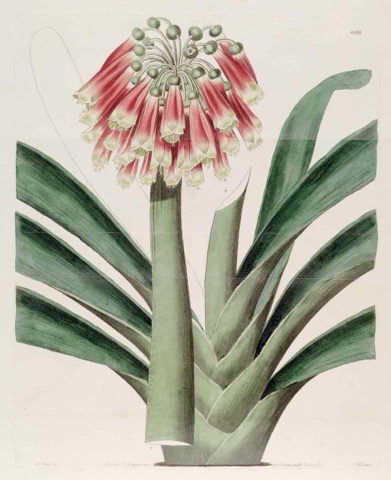
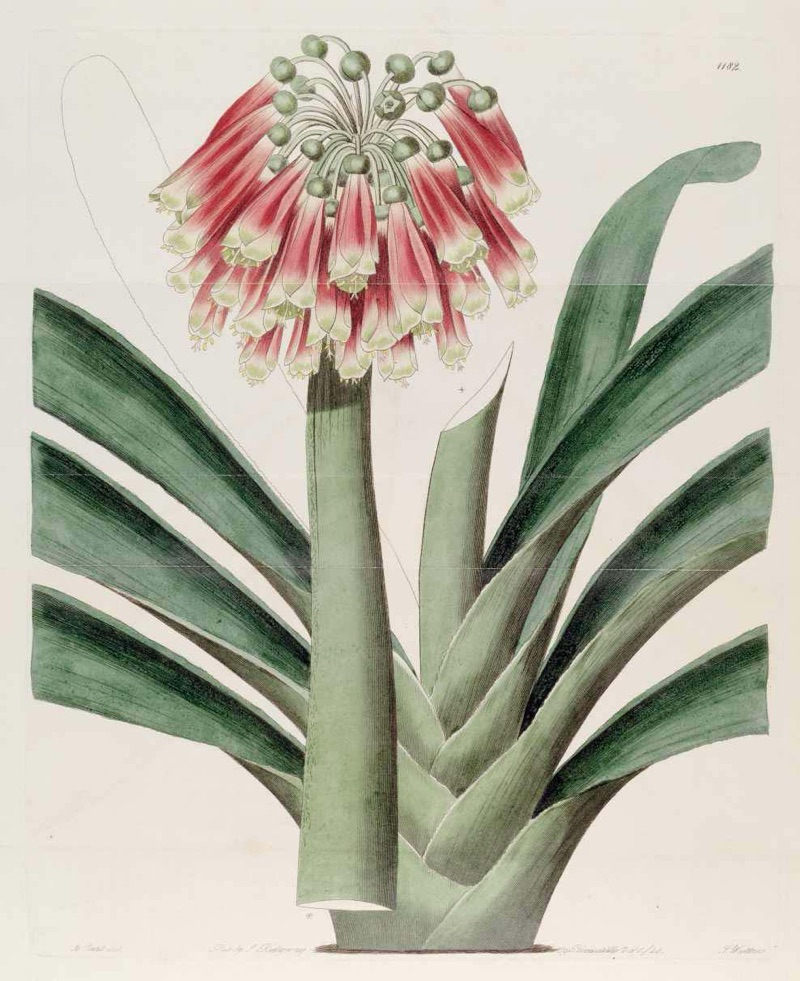
Clivia nobilis
Edwards's Botanical Register · 1182 · 1828
Clivia miniata
Favourite Flowers of Garden and Greenhouse · Pl. 263 · 1897
Pot culture and safety
The RHS advises bright, filtered or indirect light, as direct summer sun scorches the leaves. To encourage flowering, keep the plant in a cool but bright spot at about 10 °C from November to February; water sparingly in winter without letting the compost dry out completely, increase watering in spring as the flower buds form, and water regularly in summer and autumn. It warns that the sap may irritate skin, so wear gloves when handling.
The ASPCA lists clivia as toxic to dogs and cats (C. miniata also to horses): the toxic principles are lycorine and other alkaloids, causing vomiting, salivation and diarrhoea, and in large amounts convulsions, low blood pressure, tremors and cardiac arrhythmias; the bulbous base is the most poisonous part.