Antirrhinum L.
snapdragons · Plantaginaceae
- Accepted name
- Antirrhinum L.
- First published
- Sp. Pl.: 616 (1753)
- Family
- Plantaginaceae
- Accepted species
- 35 (including 8 natural hybrids)
- Native range
- 11 TDWG regions, the western and central Mediterranean
- Common names
- snapdragons
- Databases
- POWO · IPNI · WCVP · Catalogue of Life · GBIF
Overview
Antirrhinum belongs to the plantain family, Plantaginaceae; Kew gives its native range as the western and central Mediterranean. The cut snapdragon is A. majus, which WCVP records as native to France and Spain and introduced or naturalised in about 80 regions.
Classification and naming
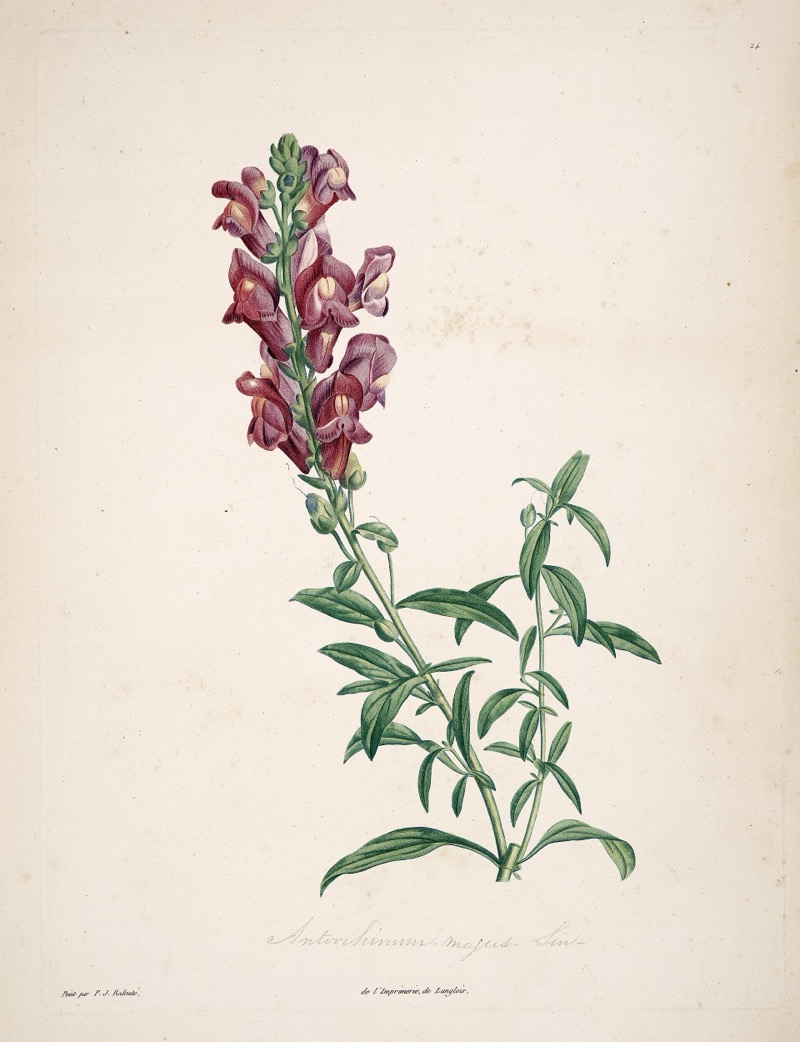
Linnaeus published the genus in Species Plantarum in 1753; several of the species WCVP accepts are natural hybrids (names with ×), listed below. The plate above is Redouté’s plate 24 for La botanique de J.J. Rousseau (1805), inscribed “Antirrhinum majus Lin.”
| Genus name | Published in |
|---|---|
| Anthirrinum Moench | Methodus: 521 (1794) |
| Antrizon Raf. | Autik. Bot.: 159 (1840) |
Distribution
WCVP records the genus as native to 11 TDWG botanical regions and introduced in 80 more.
AlgeriaFranceItalyLebanon-SyriaLibyaMoroccoPalestinePortugalSiciliaSpainTunisia
Introduced
Introduced regions (80)
AlabamaAlbaniaArgentina NortheastAssamAustriaAzoresBalearesBangladeshBelgiumBritish ColumbiaBulgariaCaliforniaCanary Is.ConnecticutCubaCyprusCzechia-SlovakiaDistrict of ColumbiaDominican RepublicEast Aegean Is.East European RussiaEast HimalayaEaster Is.GermanyGreat BritainGreeceGuatemalaHaitiIllinoisIndiaIowaIrelandJamaicaJuan Fernández Is.KazakhstanKoreaKritiKrymLeeward Is.LouisianaMadeiraMassachusettsMexico CentralMexico GulfMexico NortheastMexico SoutheastMichiganMissouriNetherlandsNew MexicoNew YorkNew Zealand NorthNew Zealand SouthNorth European RussiaNW. Balkan Pen.OhioOntarioOregonPennsylvaniaPeruPuerto RicoQuébecRomaniaSardegnaSouth European RussiaSwitzerlandTadzhikistanTasmaniaTrinidad-TobagoTürkiyeTürkiye-in-EuropeUruguayUtahUzbekistanVenezuelaVermontVietnamVirginiaWashingtonWisconsin
Accepted species
WCVP accepts 35 species; names with × are natural hybrids. The count changes with revisions; checked 2026-10-24.
| Name | On this site |
|---|---|
| Antirrhinum australe Rothm. | |
| Antirrhinum barrelieri Boreau | |
| Antirrhinum × bilbilitanum Güemes & Mateo | |
| Antirrhinum braun-blanquetii Rothm. | |
| Antirrhinum charidemi Lange | |
| Antirrhinum × chavannesii Rothm. | |
| Antirrhinum cirrhigerum (Welw. ex Ficalho) Rothm. | |
| Antirrhinum controversum Pau | |
| Antirrhinum × ferrandopardoi P.P.Ferrer | |
| Antirrhinum graniticum Rothm. | |
| Antirrhinum grosii Font Quer | |
| Antirrhinum hispanicum Chav. | |
| Antirrhinum × inexpectans P.P.Ferrer, R.Roselló, E.Laguna & Güemes | |
| Antirrhinum latifolium Mill. | |
| Antirrhinum linkianum Boiss. & Reut. | |
| Antirrhinum lopesianum Rothm. | |
| Antirrhinum majus L. | 1 plate |
| Antirrhinum martenii (Font Quer) Rothm. | |
| Antirrhinum × mazimpakae Fern.Casas | |
| Antirrhinum meonanthum Hoffmanns. & Link | |
| Antirrhinum microphyllum Rothm. | |
| Antirrhinum molle L. | 1 plate |
| Antirrhinum mollissimum (Pau) Rothm. | |
| Antirrhinum × montserratii Molero & Romo | |
| Antirrhinum × multiflorum J.Vick | |
| Antirrhinum onubense (Fern.Casas) Fern.Casas | |
| Antirrhinum pertegasii Rothm. | |
| Antirrhinum pulverulentum Lázaro Ibiza | |
| Antirrhinum rothmaleri (P.Silva) Amich, Bernardos & García-Barriuso | |
| Antirrhinum × segurae Fern.Casas | |
| Antirrhinum sempervirens Lapeyr. | |
| Antirrhinum siculum Mill. | |
| Antirrhinum subbaeticum Güemes, Mateu & Sánchez-Gómez | |
| Antirrhinum tortuosum Bosc ex Lam. | |
| Antirrhinum valentinum Font Quer |
Historic plates
Plates in date order; the printed names are kept as they appear, current names are on the species pages and the topic page.
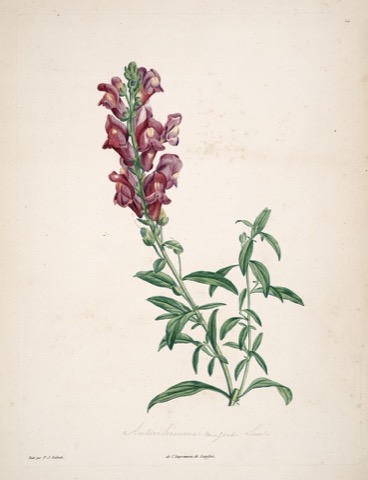
Antirrhinum majus Lin.
La botanique de J.J. Rousseau · Pl. 24 · 1805
Pierre-Joseph Redouté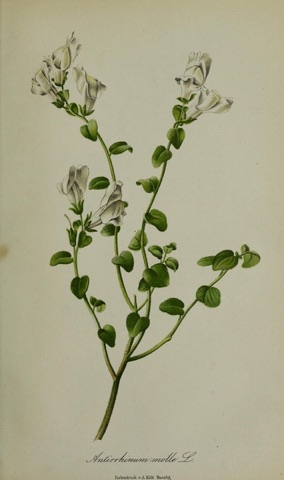
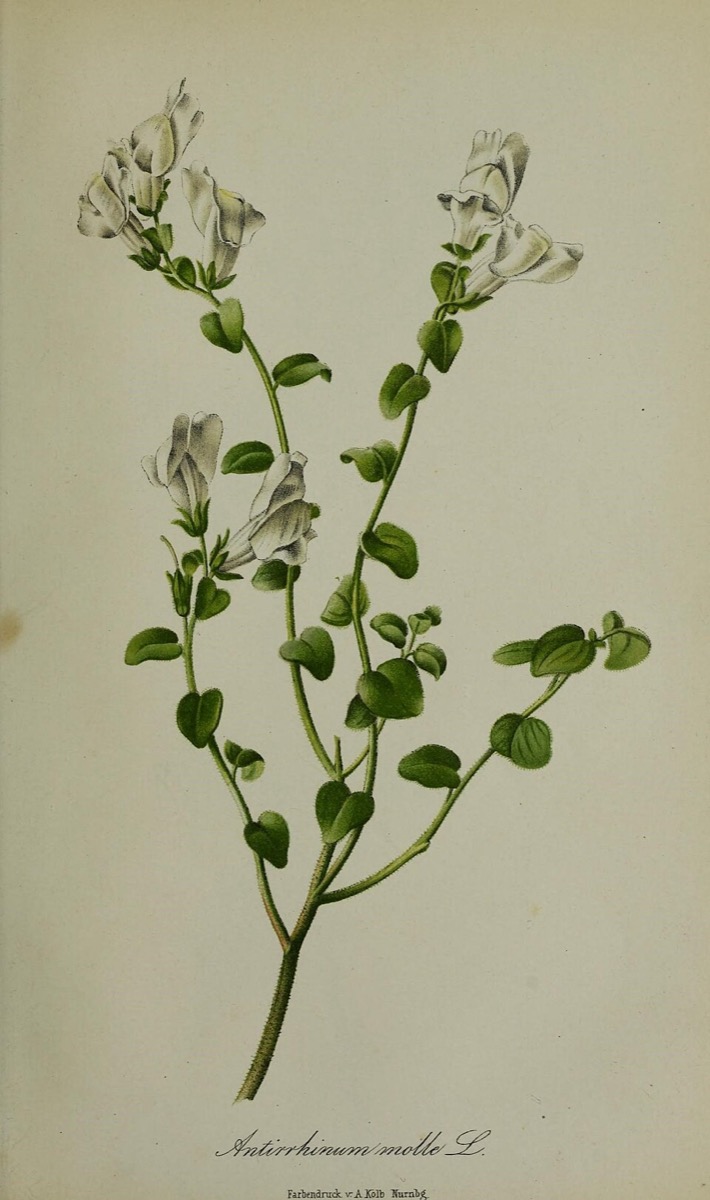
Antirrhinum molle
Gartenflora · 1853
Cut-flower handling
Floralife advises harvesting when two to five florets per stem are open, choosing straight stems with healthy, unyellowed leaves; store at 1–3 °C and 75–85% relative humidity; vase life is 5–10 days; avoid softened water. Most cultivars are ethylene-sensitive, shattering being the commonest symptom, so treat with an ethylene action inhibitor; buds may not open after ethylene damage or long storage. Snapdragons are extremely sensitive to gravity and bend upwards when stored or shipped horizontally; bent stems can straighten when hydrated under direct, bright light.
They perform well in foam and are good vertical line flowers. They are susceptible to botrytis. Do not remove more leaves than necessary, as that can make flowers fall; as the upper flowers open the lower ones die naturally; better light and flower food help against fading colour.