Agapanthus L'Hér.
African lilies · Amaryllidaceae
- Accepted name
- Agapanthus L'Hér.
- First published
- Sert. Angl.: 17 (1788)
- Family
- Amaryllidaceae
- Accepted species
- 8 (including 0 natural hybrids)
- Native range
- 7 TDWG regions, Mozambique to South Africa
- Common names
- African lilies
- Databases
- POWO · IPNI · WCVP · Catalogue of Life · GBIF
Overview
Agapanthus belongs to the family Amaryllidaceae; Kew gives its native range as Mozambique to South Africa. WCVP accepts only a handful of species, listed below. The florists’ agapanthus is recorded in the identity table as A. praecox.
The RHS divides garden agapanthus into two kinds: deciduous types lose their leaves in autumn and are “the toughest, hardiest agapanthus”, while evergreen types are more tender and best overwintered in a cool greenhouse, or grown in containers and brought indoors in cold areas. They flower from midsummer into early autumn, mainly in blues with purples and whites, and range from about 20–60 cm to 1.5 m tall.
Classification and characters
WCVP cites L’Héritier’s Sertum Anglicum (1788) as the place of publication and treats Abumon, Mauhlia and Heister’s Tulbaghia of 1755 as synonyms. The last only shares its name with the society-garlic genus, Tulbaghia L.; it is not the same genus.
Flora Zambesiaca describes the genus as perennial geophytic herbs with an upright stem and thick rhizomes, fusiform fleshy roots, and linear leaves with smooth, ridged margins.
| Genus name | Published in |
|---|---|
| Abumon Adans. | Fam. Pl. 2: 54 (1763) |
| Mauhlia Dahl | Observ. Bot.: 25 (1787) |
| Tulbaghia Heist. | Beschr. Neu. Geschl.: 15 (1755) |
Distribution
WCVP records the genus as native to 7 TDWG botanical regions and introduced in 25 more.
Cape ProvincesEswatiniFree StateKwaZulu-NatalLesothoMozambiqueNorthern Provinces
Introduced
AscensionAzoresCanary Is.Costa RicaEritreaEthiopiaFranceGreat BritainHondurasJamaicaMadeiraMexico CentralMexico GulfMexico SoutheastMexico SouthwestNew Zealand NorthNew Zealand SouthNorfolk Is.PortugalSt.HelenaTasmaniaTrinidad-TobagoTristan da CunhaVictoriaWest Himalaya
Accepted species
WCVP accepts 8 species; names with × are natural hybrids. The count changes with revisions; checked 2026-10-28.
| Name | On this site |
|---|---|
| Agapanthus africanus (L.) Hoffmanns. | 5 plates |
| Agapanthus campanulatus F.M.Leight. | |
| Agapanthus caulescens Spreng. | |
| Agapanthus coddii F.M.Leight. | |
| Agapanthus inapertus Beauverd | |
| Agapanthus pondoensis F.M.Leight. ex G.D.Duncan | |
| Agapanthus praecox Willd. | |
| Agapanthus walshii L.Bolus |
Historic plates
Plates in date order; the printed names are kept as they appear, current names are on the species pages and the topic page.
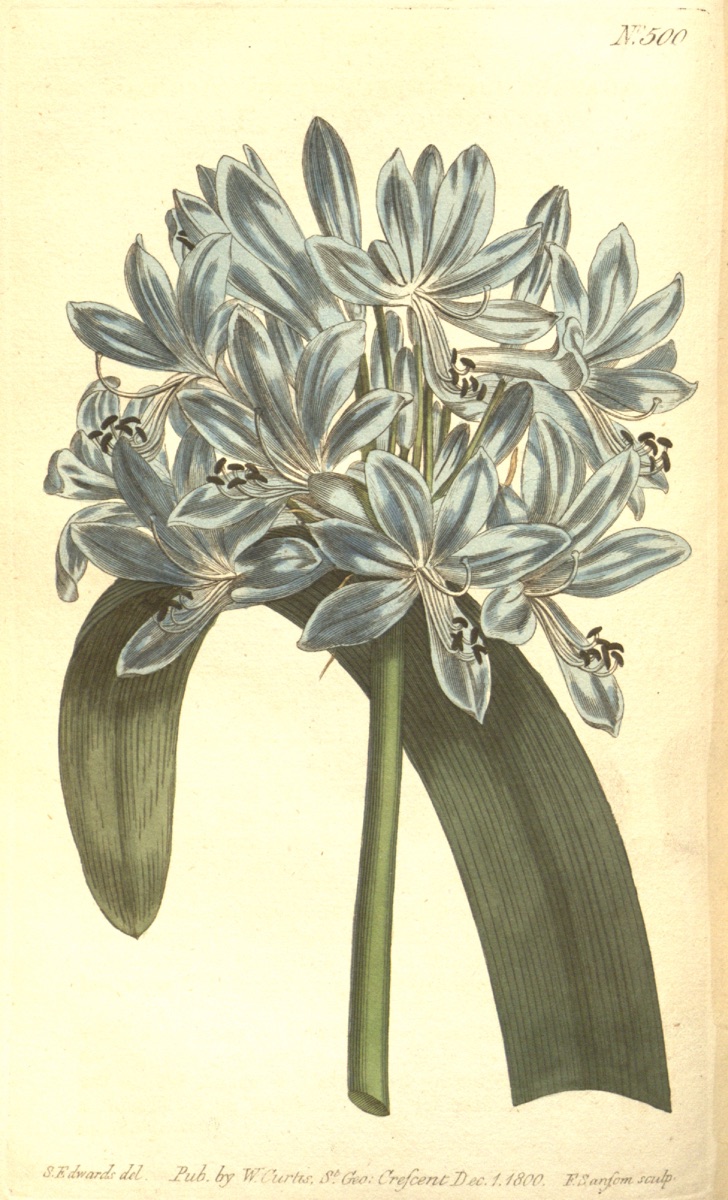
Agapanthus umbellatus
Curtis's Botanical Magazine · 500 · 1800
Sydenham Edwards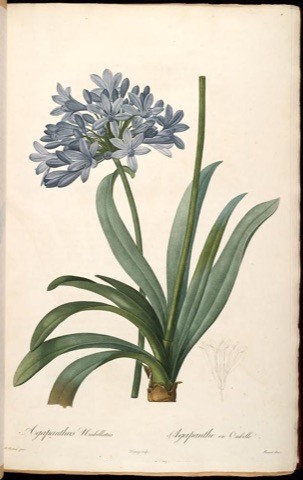
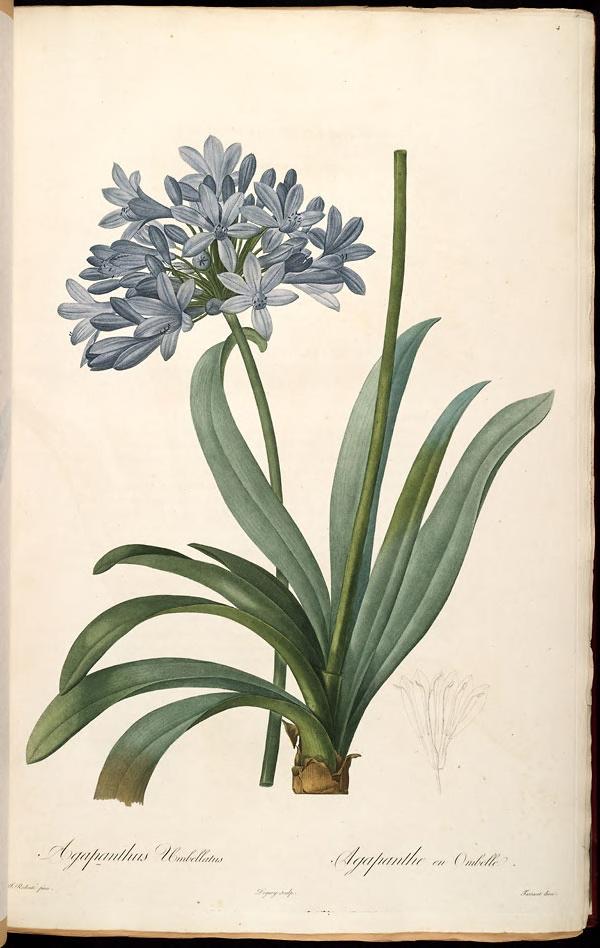
Agapanthus Umbellatus
Les Liliacées · 4 · 1805
Pierre-Joseph Redouté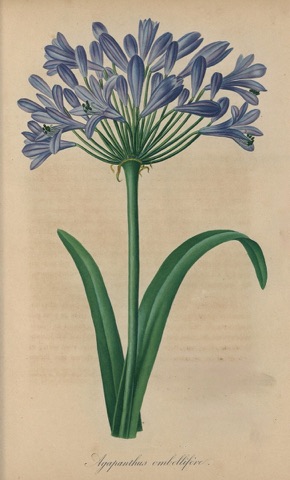
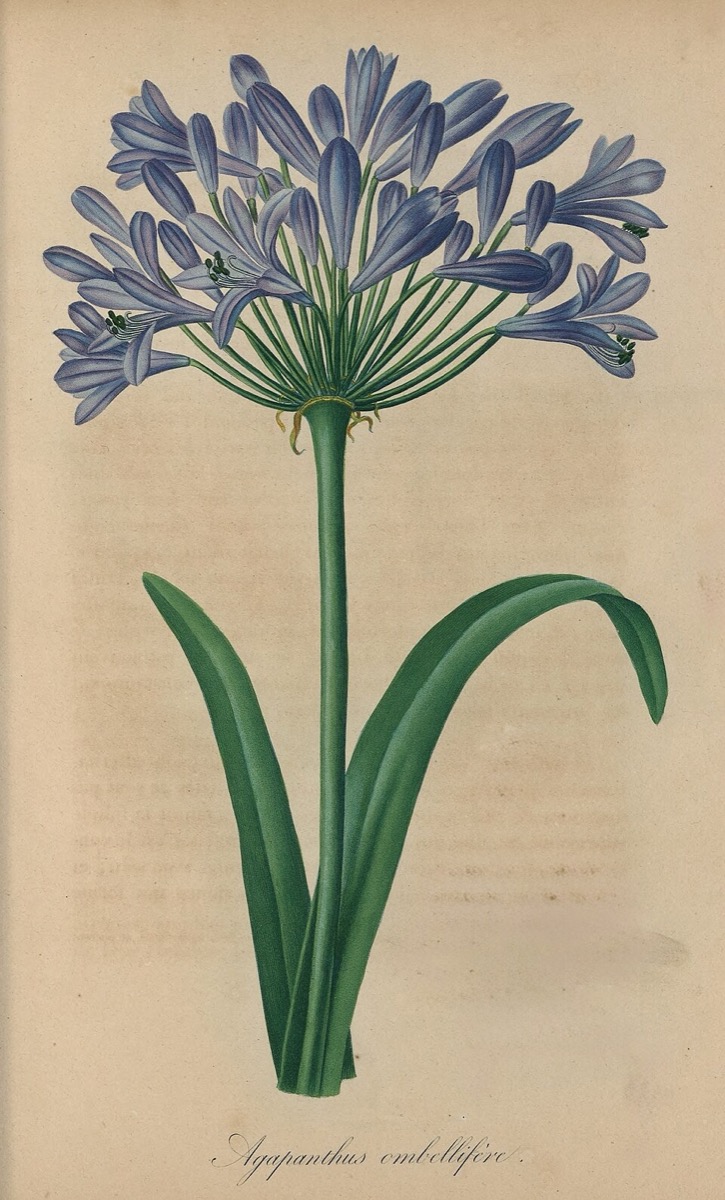
Agapanthus ombellifère
Choix des plus belles fleurs · 1837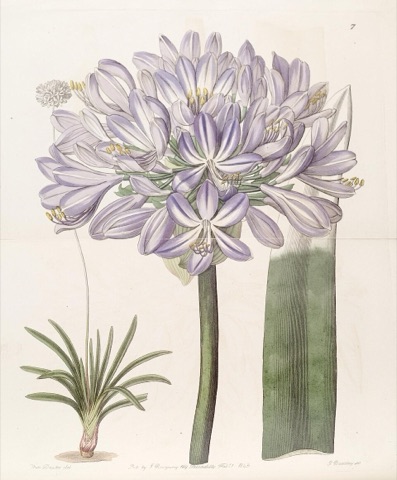
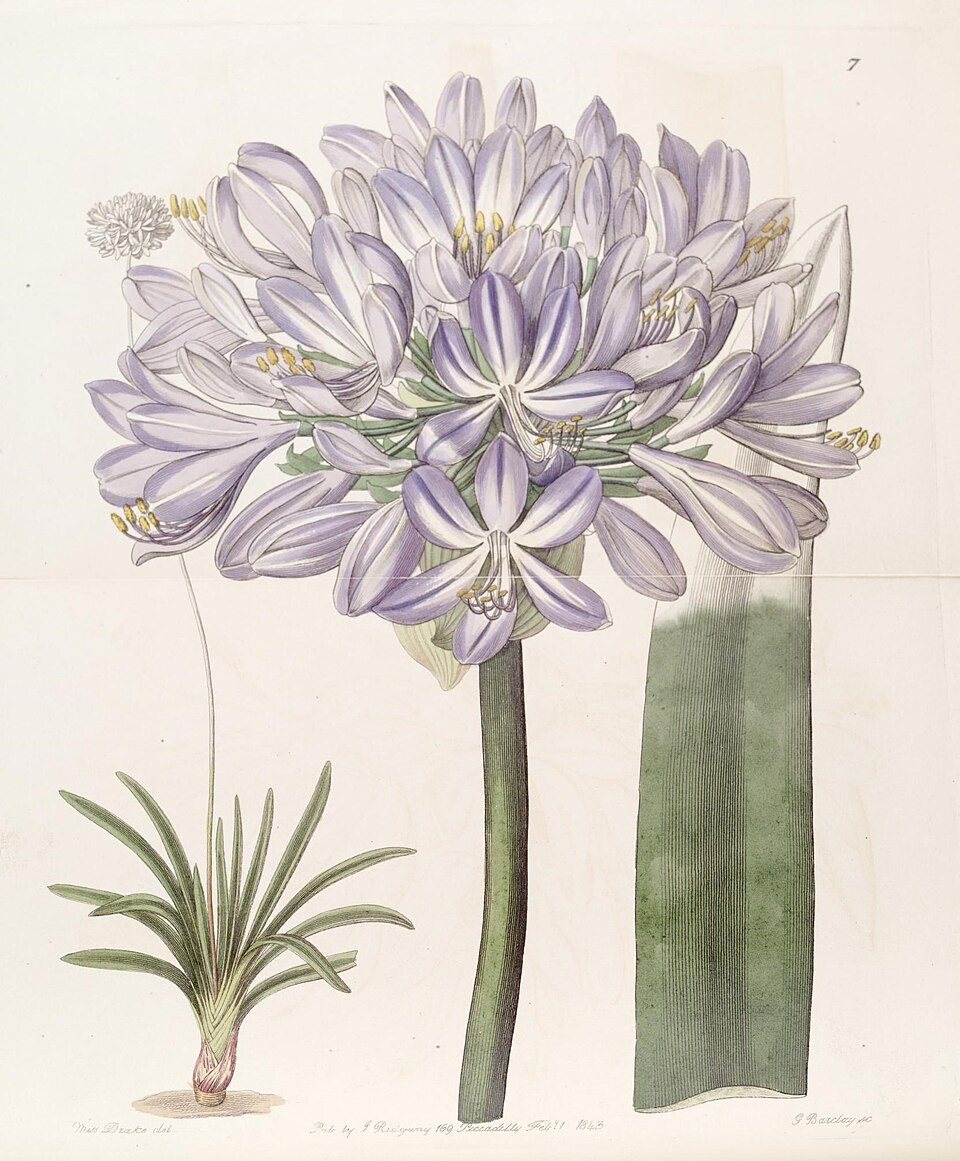
Agapanthus umbellatus
Edwards's Botanical Register · 7 · 1843
Sarah Anne Drake, G. Barclay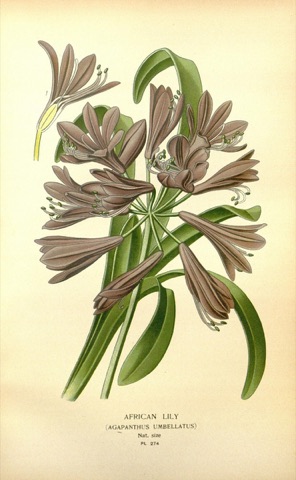
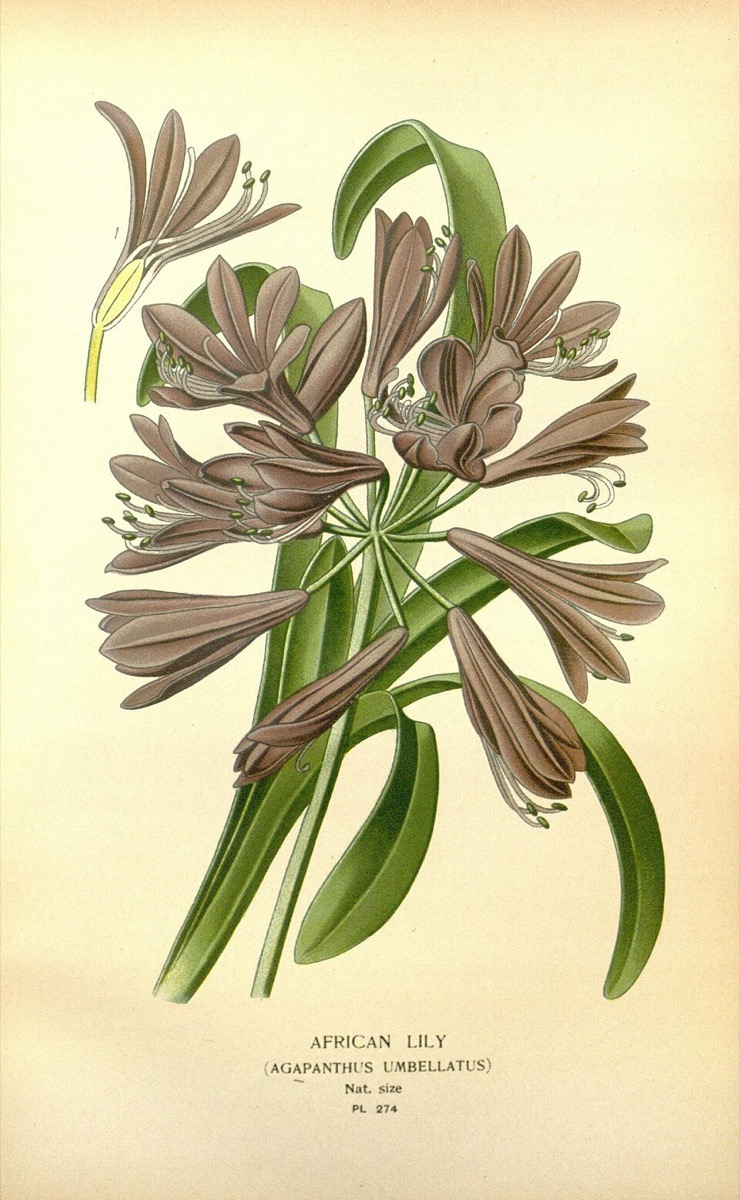
Agapanthus umbellatus
Favourite Flowers of Garden and Greenhouse · Pl. 274 · 1897
Cut-flower handling
The Floral Design Institute advises buying stems just before the first florets open, choosing tight clusters that show colour or have only a few open blooms. Remove 5–8 cm (two to three inches) of stem with a sharp knife and hydrate in water with commercial flower food before storing or using; store at 1–2 °C (34–36 °F). Vase life is 6–12 days, with florets opening in succession over several days.
Agapanthus is sensitive to ethylene. Premature floret drop is caused mainly by ethylene, especially in immature buds, and white cultivars drop more readily than blue ones.